
Guide to Selecting and Configuring LED High-Mast Lights for Traffic Intersections
Jul 08, 2026
Introduction
The quality of nighttime lighting at traffic intersections significantly impacts accident rates. Selecting LED high-mast lights involves four distinct technical dimensions: photometric design, structural mechanics, electrical control, and construction safety; errors in any of these areas can lead to operational and maintenance difficulties or serious safety hazards.
This article presents actionable selection criteria and calculation methods for reference, covering five aspects: specific application requirements, key parameters, light distribution schemes, intelligent control, and safe installation.

Clarify scenario requirements
Intersection Types:
- Four-way/T-junctions: Semi-high-mast or high-mast lighting (15–25 m), focusing coverage on the intersection area, crosswalks, and turning paths.
- Large interchanges: High-mast lighting (≥25 m); poles are positioned on the central islands enclosed by ramps, with a coverage radius of 50–80 m per pole.
- Roundabouts/Plazas: Radially symmetrical light distribution to ensure 360° illuminance uniformity of ≥0.4.
Three data points required before selection: intersection right-of-way width, number of traffic lanes, and extent of obstruction by surrounding buildings or vegetation (if the obstruction coefficient exceeds 0.3, pole placement must be adjusted or wattage increased).
Key Points for Selecting Core Parameters
Height and Pole Structure
Height calculation: Effective illumination radius R ≈ H × 1.2 (where H is the pole height; the coefficient is based on the ground projection corresponding to the LED's maximum luminous intensity angle of 65°). For single-sided lighting layouts, H ≈ W (road width); for double-sided layouts, H ≈ W/2. For heights exceeding 35m, a multi-pole layout is required.
Material: Q345B steel. Wall thickness: ≥6mm for 15–20m poles, ≥8mm for 20–30m poles, and ≥10mm for 30–35m poles. Corrosion protection: Hot-dip galvanizing (≥85μm) plus polyester coating (≥60μm); designed service life of 20 years.
Lifting System vs. Fixed Ladder:
|
Comparison Items |
Lifting |
Fixed |
|
Initial Cost |
1.35 times |
1.0 times |
|
Single Maintenance Cost |
0.3 times |
1.0 times |
|
Security Risk Level |
Level 2 (Ground Operations) |
Level 1 (High-altitude operations) |
|
Applicable Conditions |
Height ≥ 20m mandatory |
Height ≤ 15m |
≥20m must use an electric lifting system: winch 1.5-3kW, stainless steel wire rope diameter ≥6mm, safety factor ≥8 times, equipped with mechanical anti-fall device and manual emergency mechanism.
Light Source and Power
- Light source: LED; luminous efficacy ≥140 lm/W (IES LM-80); color rendering index (CRI) Ra ≥70 (CIE 13.3). With Ra <70, the time required for drivers to identify dark-colored obstacles increases by 15%–20% (CIE 230:2019).
- Color temperature: 4000K–5000K for arterial roads; 3000K–4000K for foggy areas (yellow spectrum reduces scattering loss by approximately 30%).
- Single-luminaire power ratings: 200W, 240W, 300W, 360W, 480W, 600W.
Power Configuration:
Point-by-point illuminance calculation using DIALux or AGi32 is the only reliable method for engineering design. Rough calculation formulas are used for verification purposes only:
P_total = E_avg × A / (UF × MF × η)
E_avg: Maintained illuminance; ≥30 lx for arterial roads (CJJ45-2015).
UF: Utilization factor; 0.15–0.25 for high-mast lights.
MF: Maintenance factor; 0.7.
η: Overall efficiency; 0.85.
Practical reference: For a 30m mast height and a 1,500m² intersection, meeting the illuminance standard for arterial roads requires 16–20 luminaires (400W each) per mast, or an increase in the number of masts to 3–4.
Ingress Protection (IP) Rating: IP65 for the luminaire; IP67 for the electrical compartment.
Light Distribution Design
The use of floodlights with symmetrical light distribution is strictly prohibited at traffic intersections; these fixtures produce peak luminous intensity at elevation angles of 75°–90° (ranging from 40% to 60% of peak intensity), directly causing disability glare.
CJJ45-2015 limits: Luminous intensity at 80°elevation ≤ 30 cd/1000 lm; at 90°elevation ≤ 10 cd/1000 lm.
Technical Requirements:
- Asymmetric (offset) lens; beam offset angle: 15°–25°
- Cut-off sharpness: Luminous intensity gradient within the 10° transition zone ≥ 5:1
- Spill light (behind the luminaire) ≤ 2% of peak intensity
- Light distribution type: Cut-off type (intensity attenuates to <10% of peak above 70°) or the Batwing Distribution
Luminaire Array Layout:
- Planar symmetrical type: Evenly distributed horizontal angles, consistent pitch angles; which is suitable for wide open spaces.
- Radial symmetrical type: Evenly distributed horizontal angles, pitch angles tilted outwards by 2°-5°, which is suitable for roundabouts.
- Combined asymmetrical type: Different pitch/polarization angles for different horizontal angles, which is suitable for multi-level interchanges.
During the model selection phase, it is essential to obtain IES or LDT photometric files and import them into software to verify illuminance uniformity (U0 ≥ 0.4) and the threshold increment for glare (TI ≤ 15%).
Intelligent Control Solution
Time-based + Light-based Control: Astronomical time switch based on latitude and longitude (accuracy ±5 min) + illuminance sensor (threshold 100–200 lux), and the light-based control takes priority.
Dimming Strategy:
|
Time Period |
Light Power |
Methods |
|
19:00-23:00 |
100% |
Full power |
|
23:00-05:00 |
50% |
0-10V/PWM dimming |
|
05:00-06:00 |
100% |
Recover |
Energy-saving rate: approximately 27% for the dimming scheme, and 40%–55% for the alternating-light-off scheme.
IoT Architecture:
- Single-light controller: 220V ±20%, 0-10V dimming, ±2% power metering accuracy, fault detection.
- Central controller: Communicates with luminaires via RS485/LoRa/ZigBee and backhaul to the platform via 4G/NB-IoT.
- Management platform: Automatic fault notifications, energy consumption reports, policy deployment.
Ensure the communication protocol is MQTT or HTTP RESTful API, and the use of proprietary protocols lacking secondary development interfaces is prohibited. Compliance with the requirements of GB/T 31832-2025 regarding dynamic dimming and real-time status feedback is mandatory.
Safety and Construction Requirements
Wind Load: Determine the basic wind pressure in accordance with GB 50009-2012. Moreover, the range is 0.35–0.55 kN/m² for non-coastal areas and 0.70–1.10 kN/m² for coastal areas. Wind resistance rating: ≥ Beaufort Scale 12 for non-coastal areas; As regards coastal areas, verification must be based on the 50-year return period wind pressure. The supplier must provide a "Lighting Pole Structural Calculation Report" signed and stamped by a Registered Structural Engineer, with a stress ratio of ≤ 0.85.
Lightning Protection and Grounding:
- Air-termination device: Φ25 hot-dip galvanized round steel, extending ≥ 500 mm above the highest point of the luminaire assembly.
- Down-conductor: Utilizes the pole body itself; welded to the grounding grid at ≥ 2 locations.
- Grounding electrode: Closed-loop configuration; Φ12 hot-dip galvanized round steel buried at a depth of ≥ 0.8 m.
- Grounding resistance: ≤ 4Ω(measured value); ≤ 10Ω in rocky areas (with the addition of grounding resistance reducing agents).
Foundation Construction:
- Concrete grade C30 and the volume ≥ total mass of light pole × 1.5.
- Anchor bolts (Q345/40Cr): 10 × M42 bolts (or M36 for poles under 12m); tensile strength ≥ uplift force × 1.5.
- Installation precision: flange levelness ≤ 3/1000; bolt center-to-center deviation ≤ ±2mm; height difference within the same bolt group ≤ 1mm.
- Embed 2–3 SC50/SC70 steel conduits.
Before construction, use a utility locator to verify the layout of underground utilities within 3m beneath the foundation: gas pipelines ≥ 2m, power cables ≥ 1m, and communication fiber-optic cables ≥ 0.5m. If these clearance requirements are not met, adjust the pole location or use a trenchless foundation method.

Product Recommendations
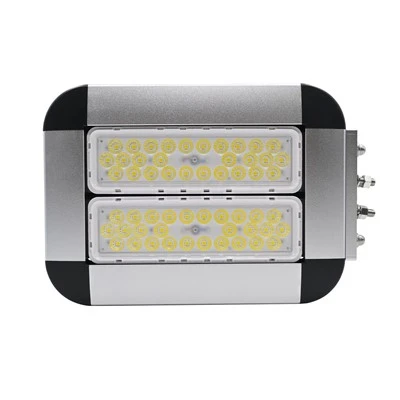
JR Lighting's JR309 series high-mast LED floodlights (50W–600W) deliver a luminous efficacy of up to 200 lm/W and a maximum output of 114,000 lumens. Featuring honeycomb and comprehensive structural heat dissipation technologies, the series supports modular assembly and offers a lifespan exceeding 50,000 hours. With IP67/IK09 protection, anti-glare PC lenses, a 180° adjustable bracket, and a vibration-resistant, anti-drop design, these lights withstand extreme environments ranging from -40°C to 50°C. They represent a versatile, industrial-grade solution for demanding applications such as sports stadiums, factories, parking lots, and traffic intersections.
Frequently Asked Questions (FAQ)
Q1: Why are high-mast lights chosen for traffic intersections instead of standard streetlights?
A: Because high-mast lights offer a wider field of view and enhanced safety. Traffic intersections often feature multiple lanes and large surface areas; standard streetlights can easily create "blind spots" of alternating light and shadow, whereas high-mast lights provide uniform, comprehensive illumination across a vast area. Furthermore, a single high-mast light can replace more than a dozen standard streetlights, significantly reducing the risk of roadside collisions with poles and eliminating the need to close traffic lanes for maintenance.
Q2: How should the height and power of LED high-mast lights at intersections be determined?
A: Industry standards are based on the size of the intersection. For small to medium-sized intersections, a height of 15–20 meters is recommended, equipped with 4–6 LED lights (200W–300W); for large intersections involving major arterial roads, a height of 25–30 meters is recommended, with 6–8 LED lights (400W–500W); and for large interchanges or traffic hubs, a height of over 30 meters is required, equipped with 8 or more high-power LED lights (500W–600W).
Q3: How can the issues of glare affecting drivers and light pollution affecting residents caused by high-mast lights be addressed?
A: The key lies in selecting the right light distribution and fixtures. Projects must move away from traditional symmetrical floodlights and instead use asymmetrical road-lighting lenses to direct light precisely onto traffic lanes and crosswalks. Additionally, full-cutoff fixtures or anti-glare shields should be employed to ensure that the light is visible while the light source itself is concealed, thereby preventing harsh glare or direct light intrusion into the windows of nearby residences.
Q4: How can the issues of glare affecting drivers and light pollution affecting residents caused by high-mast lights be addressed?
A: The key lies in selecting the right light distribution and fixtures. Projects must move away from traditional symmetrical floodlights and instead use asymmetrical road-lighting lenses to direct light precisely onto traffic lanes and crosswalks. Additionally, full-cutoff fixtures or anti-glare shields should be employed to ensure that the light is visible while the light source itself is concealed, thereby preventing harsh glare or direct light intrusion into the windows of nearby residences.
In Conclusion
The selection of high-mast lights for traffic intersections can be summarized by three key principles: height is determined by road width, light distribution is ensured by the lens, and safety is guaranteed by the lifting mechanism and grounding system. During the selection phase, it is essential to complete four preliminary reviews: an illuminance simulation report, verification of light distribution curves, an inspection report on the lifting system's steel cables, and structural calculations, to effectively address potential issues during subsequent operation and maintenance.