
A Practical Guide to Selecting LED Football Field Lighting: From Standards and Specifications to Layout
Jun 26, 2026
Introduction
For football fields operating at night, the lighting system is a critical component that determines both usage rates and the user experience. When selecting LED lighting, many facility managers focus solely on wattage and price; consequently, the finished spaces often suffer from issues such as glare, uneven brightness, severe flickering, and rapid degradation of light output. Sports lighting is far more than standard outdoor lighting; it demands industrial-grade precision regarding light control, projection angles, and operational stability. Drawing on practical project experience, we outline the key factors to consider when selecting LED lighting for football fields.
Clarify your requirements: What is the classification of your football field?
The first step in selecting LED lights for a football field is not to focus on the fixtures themselves, but to clearly define the field's intended role and usage. According to my country's *Standard for Design and Testing of Sports Venue Lighting* (JGJ 153-2016), different usage scenarios require vastly different illuminance standards and technical specifications. Blindly aiming for high standards leads to wasted budgets, whereas standards that are too low fail to meet operational needs.
|
Application scenarios |
Main uses |
Horizontal average illuminance (Eh) |
Color rendering index (Ra) |
Glare Index (GR) |
|
Amateur training and recreation |
Community 5-a-side/7-a-side games, corporate employee sports, commercial entertainment rentals |
150–200 Lux |
≥70 |
≤55 |
|
Amateur competitions and professional training |
University football fields, small and medium-sized local clubs, and city-level amateur leagues |
300–500 Lux |
≥80 |
≤50 |
|
Professional competition (no television broadcast) |
Provincial and national level official competitions, with a large number of spectators seated on site. |
500–750 Lux |
≥80 |
≤50 |
|
Broadcast of national/international competitions |
Professional league and high-definition (HD/4K/8K) television broadcasting venues |
1000–1500+ Lux |
≥90 |
≤40 |
Implementation Recommendation: For the vast majority of commercial sports fields (5-a-side, 7-a-side, and standard 11-a-side) that operate primarily on a for-profit rental basis, maintaining an illuminance level of 200–300 lux offers the best cost-performance ratio. This range ensures players can clearly track the ball's trajectory while sprinting and effectively minimizes both initial lighting procurement costs and ongoing electricity expenses.

You must understand these 5 core parameters
-
Lighting effect and wattage
Conventionally, people tend to gauge brightness based on wattage. However, in the LED era, this approach is entirely incorrect. Brightness is measured in lumens (Lm), whereas energy efficiency is measured in luminous efficacy (Lm/W).
Currently, low-quality high-power LED fixtures on the market may offer a luminous efficacy of only 80–100 Lm/W, whereas professional sports lighting from top-tier manufacturers-or fixtures utilizing high-quality chips-can achieve 130–150 Lm/W. This means that to achieve the same level of brightness, a 400W fixture with high luminous efficacy can fully replace a 600W fixture with low efficacy, resulting in an immediate 33% saving on electricity costs.
-
Beam Angle and Beam Distribution Curve
Standard commercial floodlights (such as those used for architectural illumination) emit light that spreads evenly; if mounted 10–15 meters above a sports field, the light disperses significantly in the air, making the sky appear brighter than the ground or creating intense, blinding glare. Professional LED stadium lights must feature asymmetrical light distribution (offset-beam design) or precise, narrow-to-medium-angle lenses (e.g., combinations of 15°, 30°, 45°, and 60°). These lenses direct each beam of light precisely onto specific areas of the field, ensuring high illumination uniformity on the ground while preventing light spill into nearby residential areas.
-
Glare Rating (GR)
During matches, soccer players frequently need to look up to receive long, high passes; if glare control is inadequate, looking upward can cause a momentary visual blind spot, which not only impairs performance but also significantly increases the risk of sports injuries. High-quality sports lighting fixtures incorporate specialized structural designs-such as deep anti-glare shrouds, louvers, or micro-prismatic anti-glare lenses-to strictly maintain the Glare Rating (GR) below 50.
-
Color Rendering Index (CRI/Ra) and Flicker
The Color Rendering Index (CRI) determines the accuracy of color reproduction. For standard recreational courts, a CRI (Ra) of ≥70 is sufficient; however, for school facilities or "viral" courts frequently used for filming short videos, fixtures with a CRI (Ra) of ≥80 are recommended to ensure natural skin tones and vibrant green turf in photos and videos. Additionally, the lighting drivers must be flicker-free (with a modulation depth of less than 3%); otherwise, noticeable black flickering bands will appear when recording in slow motion or using high-speed cameras.
-
Protection rating (IP) and heat dissipation structure
Outdoor football field lighting fixtures must withstand the rigors of heavy rain, high temperatures, and strong winds year-round, requiring an IP66 ingress protection rating. Furthermore, high heat is the nemesis of LEDs; for high-power fixtures, poor heat dissipation leads to severe "lumen depreciation" (where brightness drops by half after just one year of use). When purchasing, pay close attention to the heat sink design: fixtures featuring die-cast pure aluminum, honeycomb-style open convection structures, or copper heat pipe technology offer a far longer lifespan than those with cheap, fully enclosed housings.
Design Scheme: The Ideal Combination of Light Poles and Lighting Layouts
Even with high-quality lights, effective illumination cannot be achieved without a proper layout. Amateur and semi-professional football fields primarily employ the following two lighting arrangements:
-
Two-sided lighting method (multi-pole lighting)
This is the most common solution for small and medium-sized sports fields (5-a-side and 7-a-side) in communities and schools. The light poles are arranged symmetrically along the two long sides of the field.
- Futsal court: Typically equipped with two light poles on each side (four in total), with a pole height of 8–10 meters; each pole holds two 150W–200W LED lights.
- 7-a-side pitch: Typically equipped with three light poles on each side (six in total), 10–12 meters in height, with each pole mounting two 200W–300W LED lights.
Note: Light poles must not be positioned directly on the baseline, and the aiming angle of the installed luminaires relative to the ground must exceed 45° to prevent severe glare for players running along the edges.
-
Four-corner lighting setup
This method is primarily suitable for standard 11-a-side football pitches. A tall mast (typically 18–25 meters or higher) is erected at each of the four corners of the pitch. An array of lights-comprising four to ten high-power, wide-beam sports floodlights (500W–1000W)-is mounted on each mast. The advantages of this configuration are that the playing area remains free of obstructions, and light is projected inward from the four high points, resulting in exceptional overall uniformity and a strong sense of depth.
Cost-Benefit Analysis: Traditional Metal Halide Lamps vs. Modern Professional LED Lamps
When renovating older sports fields or facing tight budgets for new ones, operators often hesitate over whether to choose traditional metal-halide lamps (high-intensity discharge lamps) simply to save on initial procurement costs. Below is a comparison of the actual economic benefits, based on a standard 7-a-side field (calculated over a 50,000-hour lifespan with electricity costs at 1 RMB per kWh):
|
Comparison indicators |
Traditional metal halide lamp solution (1000W) |
Professional LED lighting solution (400W) |
Explanation of measured differences |
|
Single lamp input power |
1100W (including 100W ballast loss) |
400W (High-efficiency drive) |
LED single lamps achieve energy savings of up to 63.6%. |
|
Number of lights (to achieve equivalent illuminance) |
12 lamps |
12 lamps |
High-efficiency LEDs can be completely replaced with equivalent amounts |
|
Total electrical load |
13.2kW |
4.8kW |
LEDs significantly reduce the requirements for transformer capacity. |
|
Annual electricity cost (based on 5 hours per day) |
Approximately 24,090 yuan |
Approximately 8,760 yuan |
This directly saves 15,330 yuan in electricity bills annually. |
|
Light source lifespan and light decay |
5,000 hours (light decay exceeds 30% after 1 year) |
50,000 hours (less than 10% light decay over 5 years) |
Metal halide lamps require bulb replacement every 1-2 years. |
|
Startup features |
It needs to preheat for 5-10 minutes; if the power is interrupted during the process, it cannot be restarted immediately. |
Instant power-on, supports instant cold/hot restart |
LEDs are perfectly compatible with intelligent control systems. |

Product Recommendations:
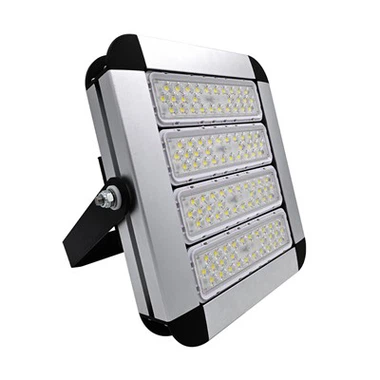
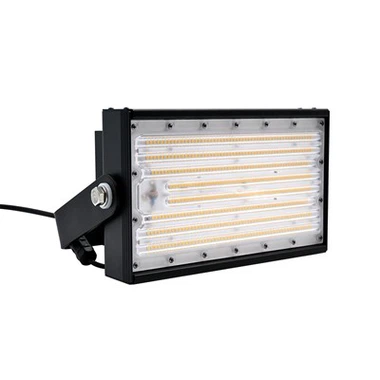
JR Lighting's JR508 series of professional LED football stadium lights offers a power range of 400W to 2400W and high luminous efficacy of up to 150 lm/W, significantly reducing electricity costs. Featuring premium imported light sources from Osram or Philips, the series achieves a high Color Rendering Index (CRI) of Ra > 90, faithfully reproducing the turf's natural color. Equipped with top-tier drivers (such as Inventronics) that support DALI 2.0 smart dimming, the lights utilize professional lenses-ranging from 10°to 90° and including an asymmetric 60° option-to ensure precise light control and glare-free illumination. With a corrosion-resistant die-cast aluminum housing and IK08/IP66-rated protection, these lights withstand heavy rain and high temperatures, making them a robust, all-in-one solution for large and medium-sized football stadiums.
Frequently Asked Questions (FAQ)
Q1: When purchasing LED lights for a football field, exactly how many lumens and watts are required?
A: You cannot simply base your purchase on wattage; you must consider lumens (the unit of brightness). When replacing existing lights, the standard industry ratio is as follows: a 1000W metal-halide lamp is typically replaced by an LED light producing 50,000–60,000 lumens (with an actual LED power consumption of only about 400W–500W), while a 1500W metal-halide lamp requires an LED light producing 80,000–90,000 lumens (with an actual power consumption of about 600W–700W). For new installations, the total lumen output for the entire field must be determined through precise light-intensity calculations using professional DIALux software, accounting for factors such as pole height and field area.
Q2: Can standard high-power LED floodlights be used directly as professional sports lighting for football fields?
A: Absolutely not. Standard floodlights emit light over a wide angle (spreading light evenly in all directions); when mounted at heights exceeding 10 meters, they cause significant light spill (illuminating the sky while leaving the ground dim) and create severe, blinding glare for the players. Professional sports lights must utilize narrow-beam or asymmetric lenses (such as 15°, 30°, or 45° light-control configurations) to project light beams with surgical precision onto specific areas of the field; furthermore, they must maintain a Glare Rating (GR) below 50 to meet the required standards.
Q3: How should "color temperature" and "Color Rendering Index" (CRI) be selected for sports venue LED lighting?
A: The ideal color temperature range for standard outdoor sports venue lighting is 5000K–5700K (neutral white/cool daylight). This range most closely resembles natural light, significantly reducing visual fatigue for players and enhancing depth perception. Regarding the Color Rendering Index (CRI/Ra): for standard community training facilities or amateur rental courts, an Ra ≥70 is sufficient. However, for schools, "viral" courts used for short-video content, or venues hosting local media broadcasts, it is essential to use high-CRI lighting (Ra ≥80 or even 90) paired with flicker-free drivers (ripple depth < 3%); otherwise, severe flickering-appearing as black bands-will occur during slow-motion smartphone recording.
Q4: When upgrading an existing traditional sports field to LED lighting, is it possible to simply remove the old fixtures and install new LED heads (a "retrofit")?
A: Yes, but a preliminary safety and technical assessment is required. Traditional metal-halide fixtures are extremely heavy; before upgrading, you must verify that the existing poles can support the new fixtures' weight and wind load. Furthermore, since the light distribution curves of LED fixtures differ significantly from those of metal-halide lights, a simple "watt-for-watt" replacement is not feasible. Instead, the manufacturer must generate a new DIALux lighting simulation based on the existing pole heights, spacing, and locations, adjusting the aiming angles of the new fixtures to ensure uniform illumination across the entire field.
In conclusion
When selecting LED lights for a football field, avoid focusing solely on wattage and price. The key is to prioritize fixtures with high luminous efficacy (>130 lm/W) and professional designs featuring asymmetric light distribution and glare control, tailored to the field's intended use (e.g., 200–300 lux for amateur or commercial facilities). During implementation, require the manufacturer to provide a DIALux lighting simulation report to ensure uniform ground-level illumination and secure a 3–5 year manufacturer's warranty; this approach guarantees energy savings, maintenance-free operation, and visual comfort for the players-preventing glare.