
How Many Lux Does a Football Stadium Need
Aug 06, 2026
Introduction
When planning lighting for a football field, determining the appropriate brightness level is often the first challenge faced by project owners and contractors. Insufficient lighting makes it difficult for players to track the ball and increases the risk of injury, while excessive lighting not only drives up installation and electricity costs but can also cause light pollution and severe glare.

The key metric for measuring the brightness of a football pitch is the lux (a unit of illuminance), representing the luminous flux received per square meter. Requirements for lux levels vary drastically depending on the specific use case. According to standards set by FIFA and the International Commission on Illumination (CIE), football pitch illuminance is categorized into the following four main levels:
Recreational and Training Level (100 – 200 Lux)
Suitable for: School sports courts, community parks, amateur training facilities, and rental pitches for 5-a-side or 7-a-side games.
Illuminance requirement: 100 – 200 Lux
Key Pain Points and Solutions:
The primary requirements at this level are cost-effectiveness and basic safety .
The lighting simply needs to enable players to clearly see the ball at their feet, distinguish the positions of their teammates, and ensure basic safety during play. While expensive, specialized lighting control equipment is not required, attention must be paid to the uniformity of the lighting layout to avoid creating areas of uneven light and shadow-where some spots are bright while others are dark.
Amateur Competition Level (200 – 500 Lux)
Applicable Scenarios: City amateur leagues, corporate tournaments, high-end sports parks, and professional club youth training grounds.
Illuminance Requirement: 200 – 500 Lux
Key Challenges and Solutions:
In amateur matches, the ball moves faster and physical contact is more intense, placing significantly higher demands on players' visual reaction speeds within the environment.
An illuminance of 200–300 lux is suitable for standard amateur matches; however, if the venue frequently hosts small-scale events with spectator stands, it is recommended to increase the level to 300–500 lux so that spectators in the stands can clearly follow the action on the court.
Professional Match Level (Non-Televised) (500 – 750 Lux)
Applicable Scenarios: Daily training bases for professional clubs, venues for provincial or municipal games, and professional stadiums without requirements for high-definition live broadcasting.
Illuminance Requirement: 500 – 750 Lux
Key Challenges and Solutions:
Professional players require extremely high levels of performance regarding passing speed and reaction times; high-quality lighting enables them to accurately judge the ball's trajectory and distance while moving at high speeds.
Furthermore, venues of this caliber typically feature large-scale spectator seating; an illuminance of over 500 lux ensures an excellent viewing experience for spectators, even in distant stands.
TV Broadcast Grade (1,000 – 2,000+ Lux)
Applicable scenarios: Venues for major international events such as national leagues, the UEFA Champions League, the World Cup, and the Olympic Games.
Illuminance requirements:
HD broadcast: 1,000 – 1,400 Lux
4K/8K Ultra-HD broadcast: 1,400 – 2,000+ Lux
Why is such high brightness required for broadcasting?
High-speed cameras and slow-motion replays: Television broadcasting-particularly slow-motion playback-requires capturing footage at high frame rates, ranging from hundreds to even thousands of frames per second. Higher frame rates necessitate faster shutter speeds and shorter exposure times; consequently, extremely high levels of supplemental venue lighting are required to prevent the image from appearing dark or grainy.
In addition to illuminance, there are two other key technical benchmarks for broadcast-grade standards:
- Illuminance Uniformity: Lighting across the entire field must be extremely uniform (with U1/U2 ratios reaching 0.7–0.8 or higher) to prevent sudden fluctuations in brightness-shifting between light and dark-when the camera pans.
- Color Rendering Index (CRI) & Flicker-free Performance: A CRI (Ra) of 80 or 90+ is typically required to accurately render the colors of the turf and jerseys. Additionally, professional flicker-free LED drivers must be used; otherwise, slow-motion footage may reveal flickering that is invisible to the naked eye but highly noticeable on camera.
Illuminance Standards Quick Reference Table
For a quick assessment, you can refer to the table below to compare against your project requirements:
|
Grade |
Venue Type |
Recommended Illuminance (Lux) |
Illuminance Uniformity (U1) |
Color Rendering Index (CRI) |
|
Class I |
Community/School/Recreational Training |
100 - 200 Lux |
≥ 0.5 |
Ra ≥ 70 |
|
Class II |
Amateur Leagues/Local Competitions |
200 - 500 Lux |
≥ 0.6 |
Ra ≥ 70 |
|
Class III |
Professional Training/Non-Broadcast Matches |
500 - 750 Lux |
≥ 0.7 |
Ra ≥ 80 |
|
HD/4K |
HD/Ultra HD TV broadcast |
1000 - 2000+ Lux |
≥ 0.8 |
Ra ≥ 80-90 |

Recommended Products
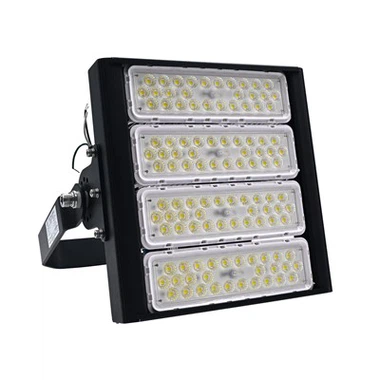
As a leading supplier of LED stadium lighting, Jingrui Lighting proudly introduces the JR508 LED football field lighting series, engineered to meet the rigorous demands of industrial and sports lighting applications. This high-performance LED stadium floodlight solution features premium Lumileds/OSRAM chips, a corrosion-resistant die-cast ADC12 aluminum housing, and high-strength tempered glass, making it ideal for harsh coastal environments. Powered by smart 1-10V/DALI 2.0 drivers and featuring precision optics, this outdoor LED stadium light delivers uniform, glare-free illumination while significantly reducing carbon emissions and routine maintenance costs.
Frequently Asked Questions (FAQ)
Q1: What level of illuminance (in lux) is required for a standard football field?
A: It depends on the intended use: 100–200 lux for community training or recreational play; 200–500 lux for amateur matches; 500–750 lux for professional matches without broadcasting; and 1,000–2,000+ lux for matches broadcast in HD or 4K.
Q2: Why do televised matches require such high illuminance levels?
A: Because broadcast cameras operate at high speeds with very fast shutter speeds and short exposure times; high illuminance is essential to ensure clear, noise-free slow-motion replays. Additionally, sufficient vertical illuminance is required to capture facial details and render colors accurately.
Q3: Besides illuminance (lux), what other factors are important for football field lighting?
A: Key factors include illuminance uniformity (to prevent uneven brightness across the pitch), glare control (to prevent blinding light from interfering with players tracking high balls), and flicker-free design (to avoid image flickering during slow-motion replays).
Q4: How can I quickly estimate the total wattage of LED lights needed for an 11-a-side football field?
A: Use the formula: "Field Area (approx. 7,140 m²) × Target Illuminance ÷ 0.6 Utilization Factor ÷ Luminaire Efficacy (approx. 140 lm/W)." For example, meeting the 300-lux standard for amateur matches requires a total power output of approximately 17–25 kW.
Summary
When planning a lighting scheme, avoid the pitfall of "blindly chasing high lux levels." Each step up in illuminance leads to an exponential increase in fixture power requirements, pole height specifications, and ongoing electricity costs.
The most sensible approach is to base the specifications on the venue's primary usage over 80% of its operational time. For community-run facilities or amateur rentals, an illuminance of around 300 lux-combined with a high-quality anti-glare design-can deliver a playing experience that far exceeds expectations.