
Complete Guide to Selecting LED Streetlights for Logistics Parks
Jul 24, 2026
Introduction
Logistics parks operate around the clock, with frequent heavy-truck traffic and continuous loading and unloading activities; their internal road networks often feature numerous curves and significant blind spots. Substandard lighting directly impacts operational efficiency and nighttime safety. Currently, most parks still rely on high-pressure sodium (HPS) lamps, which suffer from high energy consumption, frequent failures, poor color rendering (CRI of only 20–25), and uneven light distribution, leading to prominent issues such as "dark spots" beneath the lights and glare.
We provide park managers and procurement professionals with guidelines on selecting LED streetlights for logistics environments, highlighting key performance indicators.

Three Key Special Requirements for Logistics Park Lighting
High Safety and High Color Rendering: The loading/unloading area requires clear visibility of cargo labels and hand signals; the Color Rendering Index (CRI) must be at least 70, with 80 or higher recommended. The road glare Threshold Increment (TI) must not exceed 10% (CJJ 45-2015).
High Durability: Must withstand heavy vehicle vibrations, exhaust corrosion, heavy rain exposure, and extreme seasonal temperature fluctuations. Minimum ingress protection rating of IP65 (IP66 recommended) and an impact protection rating of IK08 or higher.
Extended Operation and Smart Control: Requires an average daily illumination of over 12 hours and an annual operating time exceeding 4,000 hours. High luminous efficacy is required to reduce electricity costs, and smart control interfaces must be included.
Five Steps for Selecting Lighting Fixtures
Step 1: Check Luminous Efficacy and Power
The standard GB 37478-2025 (effective June 2026) sets the energy efficiency baseline for LED road lighting fixtures at 130 lm/W; for procurement, select products with an efficacy of ≥130 lm/W.
- Arterial roads (heavy vehicle traffic): 150W–200W; average illuminance ≥20 lux; uniformity (U0) ≥0.4.
- Secondary roads/pedestrian walkways: 80W–120W; average illuminance ≥15 lux.
- Loading/unloading docks and parking lots: Combination of floodlights and streetlights; illuminance on the work surface: 200 lux–300 lux.
Step 2: Consider Light Distribution and Optical Design
Opt for polarized or "batwing" light distribution; this stretches the light along the roadway, allowing for a pole spacing of 40–45 meters and reducing dark spots. Ensure a cut-off angle of at least 15° and avoid excessive downward tilt of the luminaire head to prevent direct glare for oncoming traffic.
Step 3: Consider Protection and Heat Dissipation
Look for IP65/IP66 ingress protection and an impact resistance rating of IK08 or higher. For heat dissipation, choose a one-piece die-cast aluminum design-reducing the junction temperature by 10°C roughly doubles the lifespan. Reputable products should provide an LM-80 report.
Step 4: Consider the Power Supply and Lightning Protection
Power supply issues account for over 70% of LED failures. Select drivers from brands such as Inventronics, Mean Well, or MOSO, ensuring a power factor (PF) of ≥0.95. Lightning protection ratings should be at least 6 kV (line-to-line) and 10 kV (line-to-ground); for open areas, 10 kV–20 kV protection is recommended.
Step 5: Check for Smart Interfaces
Verify whether NEMA or Zhaga standard interfaces are provided. These interfaces allow for the plug-and-play installation of microwave sensors, scheduled dimming controls, or IoT modules at a later stage without the need for rewiring. Article 10.3.7 of GB 51157-2016 stipulates that centralized intelligent control systems should be adopted for outdoor lighting.
Comparison of Traditional Lighting and ROI Analysis
|
Comparison Items |
250W high-pressure sodium lamp |
120W LED street light |
|
System Power Consumption |
Approximately 285W (including ballast) |
120W |
|
System Lighting Effects |
Approximately 45 lm/W |
≥130 lm/W |
|
Color Rendering Index |
20-25 |
≥70 |
|
Life |
12,000-24,000h |
≥50,000h |
|
Start up |
Preheat for 3-5 minutes |
Instantaneous |
|
Annual Maintenance Fee/Lamp |
120-180 yuan |
10-20 yuan |
Calculation for 100 units (12 hours/day average; electricity rate: 0.7 RMB/kWh):
- Annual electricity cost for sodium lamps: 285W × 12h × 365 days × 100 units ÷ 1,000 × 0.7 RMB/kWh = 87,381 RMB
- Annual electricity cost for LED lamps: 120W × 12h × 365 days × 100 units ÷ 1,000 × 0.7 RMB/kWh = 36,792 RMB
- Annual electricity cost savings: 50,589 RMB; annual maintenance savings: approx. 12,000 RMB; total annual savings: 63,000 RMB.
Investment for retrofitting 100 units: approx. 180,000–220,000 RMB (including installation); payback period: 3–3.5 years. LED lifespan: 50,000 hours (approx. 12 years); savings beyond the payback period represent pure profit.

Product Recommendations
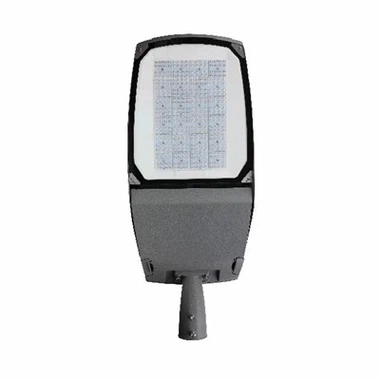
The SL16 street light features a high-pressure die-cast aluminum housing, operates in extreme temperatures ranging from -40°C to 50°C, and boasts IP66/IK09 protection ratings. Equipped with high-quality 5050 LED sources and specialized lenses, it achieves a luminous efficacy of up to 160 lm/W and 98% light transmittance. It offers multiple light distribution patterns (Types I, II, and III) and an adjustable tilt angle of -10° to 15° to ensure uniform illumination. A modular, dual-clip "plug-and-play" design facilitates easy installation and maintenance while supporting future smart dimming system upgrades. The unit offers 10kV/20kV surge protection and vibration resistance; it is eco-friendly and radiation-free, and holds IEC62471 photobiological safety certification.
Frequently Asked Questions (FAQ)
Q1: How should LED street light wattage and illuminance levels be selected for the roadways and operational areas of a logistics park?
A: For main roadways, it is recommended to use 100W–150W lights mounted at a height of 8–10 meters, ensuring an average illuminance of 20–30 lux. In contrast, areas designated for nighttime loading, unloading, and hoisting operations require high visibility; therefore, 150W–250W high-mast lights or floodlights (mounted at 12–20 meters) are recommended, with illuminance increased to 50–100 lux to eliminate dark spots.
Q2: Given the high cab position and frequent traffic of heavy-duty trucks, how can street light glare be prevented from affecting drivers?
A: When selecting fixtures, priority must be given to those featuring "batwing" light distribution lenses and deep anti-glare designs. These features extend longitudinal illuminance uniformity and control the upward light angle, preventing intense light from shining directly into the eyes of drivers in high cabs and causing momentary blindness.
Q3: Given the harsh outdoor environment and high levels of vibration in the facility, what are the mandatory requirements for the lighting fixtures' protection ratings?
A: The fixtures must meet IP66 standards (protection against heavy rain and dust) and IK08–IK10 ratings (resistance to high-intensity vibration and impact). Additionally, the housings must be constructed from ADC12 die-cast aluminum with an anti-corrosion coating to prevent loosening or water damage caused by the vibrations and crushing forces of heavy trucks.
Q4: Is it necessary to install an intelligent control system for streetlights in logistics parks?
A: It is highly necessary. By using individual lamp controllers to enable full brightness during the first half of the night, automatic power reduction (to 30%–50%) during low-traffic periods in the second half, or motion-activated lighting (brightening when vehicles approach), parks can achieve additional energy savings of over 30%. Furthermore, the system enables automatic fault alerts, significantly reducing the costs associated with maintenance and inspections.
Conclusion
Selecting street lighting for logistics parks involves procuring a comprehensive system that addresses light quality, lifespan, smart capabilities, and cost reduction. Decisions should not be based solely on price and wattage; instead, factors such as luminous efficacy (lm/W) and the warranty period must be considered-while the industry standard is five years, high-quality projects now often feature eight-year warranties. Even with identical wattage, different light distribution patterns yield vastly different results; therefore, manufacturers should be required to provide light distribution curves and illuminance simulations. Proceeding with bulk procurement only after verifying actual lighting performance and reliability is the best way to minimize the risk of selection errors.