
How Many Lights on a High Mast Pole? Configuration Guide
Oct 19, 2026
Introduction
High mast lighting plays a pivotal role in delivering safe, uniform, and reliable illumination across expansive outdoor areas. From container terminals and airport aprons to busy highway interchanges, industrial logistics hubs, and sports stadiums, determining the right setup is essential for operational efficiency and safety.
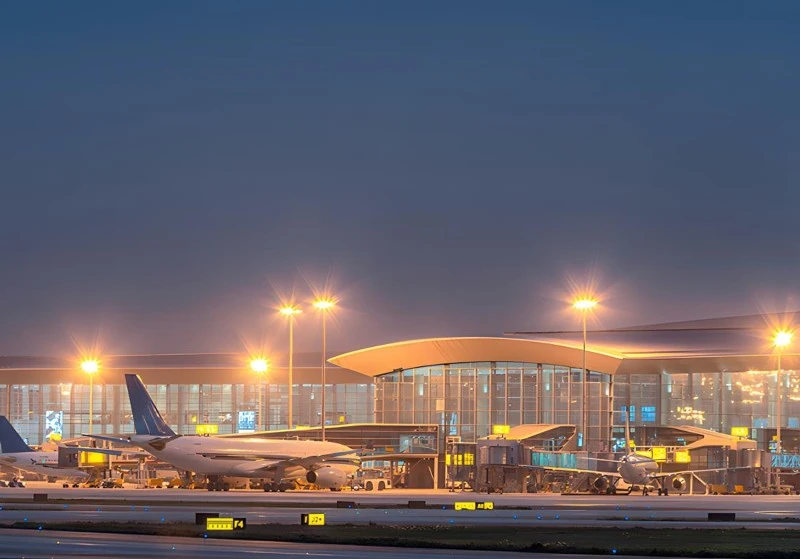
A central question buyers, engineers, and facility managers face during project planning is: How many fixtures should be installed on top of a single high mast pole?
There is no one-size-fits-all answer. Depending on pole height, total target area, required illuminance (lux level), and luminaire specifications, a high mast system typically features anywhere from 4 to over 20 LED floodlights.
This guide covers the core factors governing fixture selection, typical configuration benchmarks by application, and best practices for calculating the ideal setup for your commercial or industrial site.
Key Factors Determining the Number of High Mast Fixtures
Determining luminaire quantity requires balancing optical performance, structural capacity, and site safety standards. Four core variables dictate the final count:
Mounting Height and Target Area
High mast poles generally range from 15 meters (50 ft) to over 45 meters (150 ft). Higher mounting points distribute light across broader footprints, but light intensity decreases over distance following the inverse-square law. To maintain proper ground lux levels across vast locations, higher masts require more fixtures or higher-wattage units.
Required Illuminance (Lux) and Uniformity
Illumination standards vary drastically depending on field activity:
- Storage Yards & Interchanges: Basic navigation and security typically require 20 to 50 Lux.
- Airport Aprons & Freight Ports: Heavy machinery handling and aircraft servicing demand 50 to 100 Lux.
- Sports Arenas & Broadcasting Venues: High-definition TV broadcasting requires uniform lighting reaching 500 to 1,500+ Lux.
Higher lux requirements and strict uniformity targets demand additional luminaires angled precisely across the space.
Wattage, Efficacy, and Optics
Modern high-efficacy LED floodlights (140–160 lm/W) in power ranges from 400W to 1200W+ have replaced legacy High-Pressure Sodium (HPS) and Metal Halide systems. High-output LEDs generate equivalent or superior foot-candles using fewer total fixtures.
Additionally, beam angles directly affect luminaire counts:
- Narrow Beams (15°–30°): Ideal for long-throw illumination on taller poles.
- Wide Beams (60°–120°): Best suited for low-to-mid heights requiring broad, near-field coverage.
Frame Design and Wind Load Constraints
The headframe or luminaire ring design determines maximum structural load:
- Circular / Ring Headframes: Provide 360-degree symmetrical light distribution-common in port yards and open plazas, accommodating 6 to 20+ fixtures.
- Asymmetrical / Rectangular Racks: Direct output toward targeted directions-ideal for highway junctions and stadium sidelines, housing 4 to 16 fixtures.
- Structural Safety Limits: The cumulative weight and EPA (Effective Projected Area) of all mounted floodlights must remain strictly within the load and wind-resistance thresholds of the pole and internal winch system.
Typical High Mast Lighting Configurations by Application
Below are industry-standard benchmark configurations used across common industrial and municipal projects:
| Application / Site Type | Typical Pole Height | Recommended Fixture Count | Common LED Wattage | Optical & Photometric Focus |
| Highway Interchanges & Toll Plazas | 15m – 20m (50–65 ft) | 4 – 8 Fixtures | 240W – 400W | Medium-wide beam distribution; glare control for drivers |
| Logistics Parks & Rail Terminals | 20m – 30m (65–100 ft) | 6 – 12 Fixtures | 400W – 800W | Symmetrical 360° coverage; high ground-level visibility |
| Seaports & Container Terminals | 25m – 35m (80–115 ft) | 8 – 16 Fixtures | 600W – 1000W | Asymmetrical optics; C5-M marine anti-corrosion coating |
| Airport Aprons & Taxiways | 25m – 30m (80–100 ft) | 8 – 16 Fixtures | 500W – 1000W | Sharp cutoff optics; zero skyglow and glare prevention for pilots |
| Stadiums & Outdoor Sports Arenas | 30m – 45m+ (100–150 ft+) | 12 – 24+ Fixtures | 1000W – 1500W | High color rendering (CRI > 80/90); precise narrow-throw targeting |
Product Recommendations
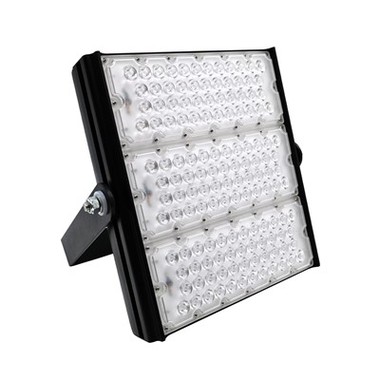
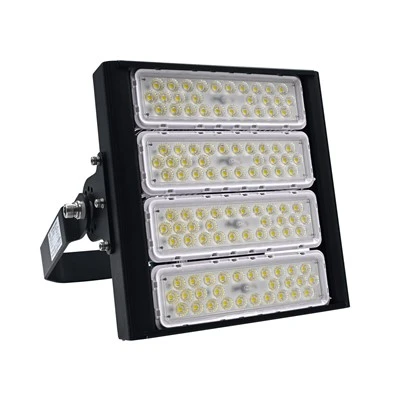
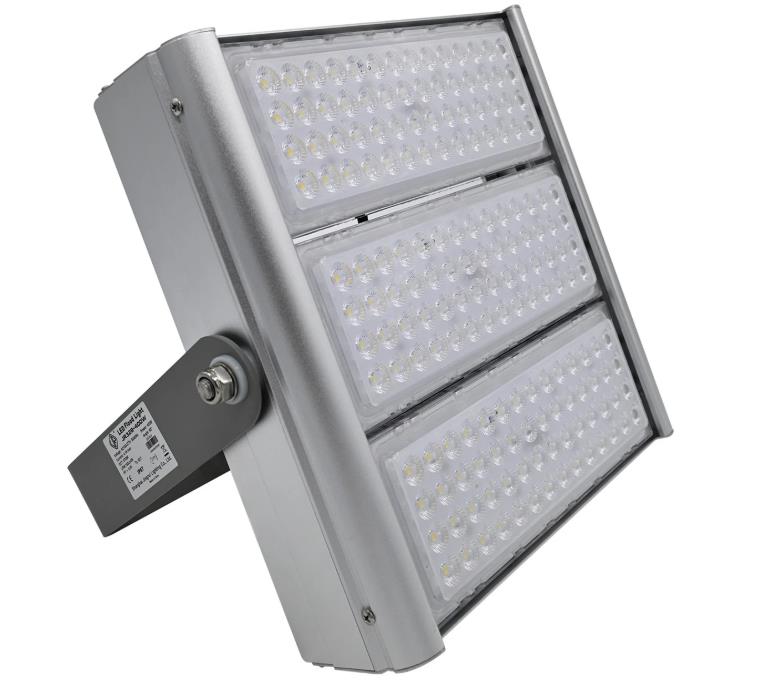
The 6000K Modular High Mast Light (Model JR328) offers a power range from 100W to 600W with high efficacy up to 160 Lm/W. Featuring premium SMD chips, air-duct heat dissipation, and 30°/60° precise beam angles, it delivers durable, uniform illumination tailored for large industrial venues like ports, airports, and sports fields.
Frequently Asked Questions (FAQ)
Q1: How Many Light Fixtures Are Typically Installed On A High Mast Pole?
A: Most industrial high mast systems feature 4 to 16 fixtures per pole (up to 20+ for specialized high-lux applications like sports arenas). The exact quantity depends on pole height, target ground illuminance (lux level), and individual luminaire wattage. For example, 15m–20m (50ft–65ft) poles usually mount 4–8 floodlights, while 25m–35m (80ft–115ft) masts typically utilize 8–12 high-output LED fixtures.
Q2: Can You Mix Different Wattages Or Beam Angles On The Same High Mast Ring?
A: Yes, mixing beam angles and wattages is a common practice in professional photometric design. Combining narrow beam optics (for long-throw perimeter coverage) with wide beam optics (for near-field illumination directly beneath the mast) eliminates dark spots and optimizes ground uniformity. However, the headframe layout must maintain balanced weight distribution and wind-load resistance.
Q3: How Do You Calculate The Exact Number Of Lights Needed For A High Mast Project?
A: Accurate fixture counts are determined through DIALux photometric modeling software rather than simple estimation. Lighting engineers input site dimensions, required lux levels (e.g., 30–50 Lux for port yards, 50–100 Lux for airport aprons), pole mounting height, and luminaire photometric files (.IES/.LDT) to simulate precise light output, tilt angles, and total fixture requirements.
Q4: Will Upgrading From HPS To LED High Mast Lights Reduce The Total Fixture Count?
A: In most cases, yes. High-efficiency LED floodlights (140–160 lm/W) deliver directional light control with significantly higher lumen output and lower optical loss compared to traditional High-Pressure Sodium (HPS) lamps. Replacing legacy fixtures with high-output LEDs often allows you to achieve equal or superior ground lux levels using 20% to 30% fewer luminaires.
Summary
In modern industrial and commercial projects, the most common setup features 6 to 12 high-output LED floodlights mounted on a 20m to 30m pole. However, the precise number depends on your target lux level, site layout, and structural limits.
Working with an experienced LED manufacturer capable of delivering customized DIALux photometric layouts ensures your facility achieves optimal lighting performance, energy efficiency, and regulatory compliance.