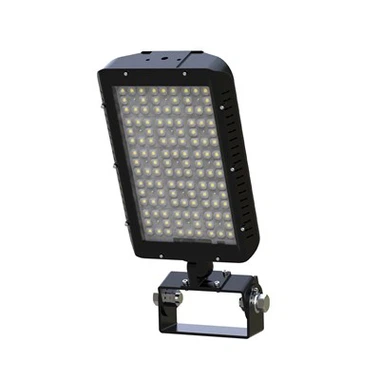

Vertical Illuminance in LED Stadium Lighting: Key to TV Broadcasting
Oct 16, 2026
Introduction
When watching nighttime football leagues or major sporting events, have you ever encountered this question: the stadium looks brightly lit and the grass is lush, but the picture on TV always seems a bit off-the expressions on the players' faces are dull, the picture is full of noise when the high-speed slow-motion replay is played, and even the football flying high in the air is "invisible" in the picture at one point?

The crux of the problem often lies not in the total power of the lighting system, but in a core optical metric that is often overlooked by many venue builders- vertical illuminance (Ev) .
What Is the Vertical Illuminance of Stadium Lights?
In traditional sports stadium lighting planning, people are most familiar with horizontal illuminance (Eh) .
- Horizontal illuminance (Eh) : refers to the luminous flux density of light projected onto a horizontal surface (such as a lawn or wooden floor), which determines whether the surface is "bright" or not, and mainly serves the visual needs of athletes and spectators on site.
- Vertical illuminance (Ev) : refers to the illuminance value of light projected onto a plane perpendicular to the ground (such as an athlete's face, side of the body, or a sphere in mid-air), measured in lux (Lux).
The camera's "physical perspective" determines the importance of vertical illumination.
Most spectators at the stadium are looking down or at an angle at the entire field, and what they see with their naked eyes is a large area of reflected light from the ground; while broadcast-level cameras (especially the main camera Camera 1 and close-up shots from the sidelines) are mostly positioned horizontally or at a low angle. The camera lenses are not "seeing" the grass, but rather the athletes and the ball standing on the field . If there is only horizontal illumination and a lack of sufficient vertical illumination, the targets captured by the camera will become "dark silhouettes against a bright background".
Why Is Vertical Illumination So Important for Television Broadcasting?
With the widespread adoption of 4K/8K ultra-high-definition broadcasting and high frame rate slow-motion technology, the requirements for lighting in sports broadcasting have become more demanding than ever before.
Capture High-Resolution Facial Close-ups and Sponsor Benefits
Modern sports broadcasting relies heavily on close-ups of star players and emotional impact. Sufficient vertical illumination clearly reveals an athlete's sweat, gaze, and facial muscle movements. Simultaneously, sponsor logos on club jerseys and advertising boards also fall on vertical surfaces, making high vertical illumination a direct prerequisite for ensuring the exposure of brand sponsors' rights.
Adapting to Exposure Requirements of HD and 4K/8K Cameras
The higher the resolution, the more demanding the camera sensor's sensitivity to low light conditions becomes. Insufficient vertical illumination causes the lens's CMOS sensor to automatically increase the ISO gain, resulting in a significant amount of noise and color distortion in the broadcast footage, thus ruining the 4K/8K image quality experience.
Meeting Exposure Requirements of High-Speed Slow-Motion Cameras
When analyzing offside, game-winning, or foul details, broadcast-quality super slow-motion cameras shoot at frame rates exceeding 1000 FPS . This means that the shutter speed for a single frame is only a fraction of a second or even less. Without extremely strong lighting in the vertical direction, super slow-motion replays will become incredibly dark or filled with noise.
Ensuring Image Quality Uniformity During Multi-Camera Switching
Large-scale events are typically equipped with 10-30 cameras at different angles (main camera, baseline camera, aerial camera crane, etc.). If the vertical illumination uniformity (U1, U2) of the venue is not well controlled, the broadcast image will show obvious flickering when switching between different camera positions, which will seriously affect the viewing experience.
Quick Reference Guide to Vertical Illuminance Standards for International Sports Events
According to the latest lighting guidelines from FIFA, UEFA, and the International Olympic Committee (IOC), the requirements for vertical illuminance vary significantly depending on the level of competition:
|
Competition Level |
Applicable Scenarios |
Vertical Illuminance Requirement (Ev) |
Broadcast Specifications |
|
Class III |
Community training/Amateur competition |
200 - 300 Lux |
No broadcasting requirement |
|
Class II |
Regional competitions/Local leagues |
500 - 700 Lux |
Basic local broadcast |
|
Class I |
National League / Standard HD Broadcast |
1000 - 1200 Lux |
High-definition (HD) live broadcast |
|
Broadcast Elite |
FIFA World Cup / UEFA Champions League / Olympics |
1500 - 2000+ Lux |
4K/8K HDR + 1000fps Super Slow Motion |
How Can Excellent Vertical Illuminance Be Achieved Through a Professional LED Lighting System?
Achieving high-quality vertical illumination is not simply a matter of "adding more lights" or "increasing power," but rather requires precise physical optics design:
- Using LED fixtures with polarized/asymmetric optical lenses can deflect light that would otherwise be scattered downwards, projecting it precisely "sideways" onto the athletes' bodies and faces, improving vertical illuminance utilization, while preventing glare from direct light shining into the players' eyes.
- Scientific planning of light pole height and targeting angle: The targeting angle of the light fixture is usually controlled between 60° and 70° . Too large an angle (too vertically downward) will result in insufficient vertical illumination; too small an angle (too close to horizontal projection) will produce severe glare (GR), affecting the performance of players and the vision of the audience.
- Beyond illuminance values, LED driver power supplies must be completely flicker-free (amplitude fluctuation < 1%) and have a TV Lighting Consistency Index (TLCI) of 90 or higher to ensure that the camera perfectly reproduces true colors.
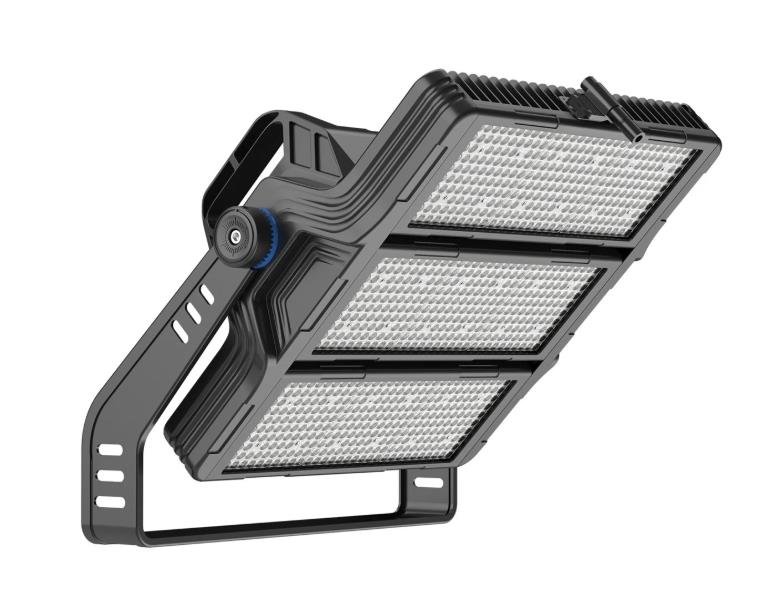
JR Lighting's JR506 high-power LED floodlight boasts a maximum power of 1500W and a luminous efficacy of 150Lm/W. It utilizes a top-tier light source with high lightning protection and intelligent dimming (1-10V/DALI2.0) driver. The die-cast aluminum housing is paired with high-strength tempered glass, offering corrosion and rust resistance, IK08 impact protection, and excellent heat dissipation, making it perfectly suited for coastal areas and extreme environments ranging from -35℃ to 50℃. It features 10° to 90° and professional asymmetrical multi-angle light distribution. With a 5-year warranty, it has passed a full set of international authoritative certifications including UL, ETL, DLC, TUV, CB, ENEC, CE, SAA, FCC, RoHS, and CQC , making it a quality choice for top-tier sports stadium lighting and industrial lighting!
Frequently Asked Questions (FAQ)
Q1: What is the vertical illuminance (Ev) of LED stadium lights?
A: Vertical illuminance refers to the light intensity projected onto a plane perpendicular to the ground (such as a human face, a jersey, or a sphere in mid-air), measured in Lux; it determines whether a face or a sphere is clear in the camera lens, while horizontal illuminance only determines whether the ground is bright or not.
Q2: Why do television broadcasts have extremely high requirements for vertical illumination?
A: The cameras are mostly horizontal shooting angles. The high vertical illumination can clearly present close-ups of the players' faces and sponsor logos, provide sufficient light for 4K/8K image quality to avoid noise, and meet the exposure requirements of extremely short shutter speeds for 1,000-frame super slow motion playback, while ensuring that the trajectory of the ball flying at high altitude does not miss the target.
Q3: What are the standards for vertical illuminance at international broadcast-level sporting events?
A: Non-broadcast venues only need 200–500 Lux, HD broadcasts need 1000–1200 Lux, while top-tier 4K/8K broadcasts such as FIFA or the Olympics require a vertical illuminance of 1500–2000+ Lux and a uniformity of 0.6 or higher for the main camera position.
Q4: How can vertical illuminance be effectively increased in lighting design?
A: An asymmetric polarizing lens is needed to project light laterally onto the facade, and the projection angle of the luminaire should be controlled between 60° and 70° to balance illuminance and glare. It should also be paired with a flicker-free driver with TLCI ≥ 90 to ensure true color reproduction of the lens.
In Conclusion
Vertical illuminance serves as a visual bridge connecting "live competition" with "global audience screens." When planning or upgrading stadium lighting, never make decisions based solely on "ground illuminance (Eh)" or "lamp wattage (W)."
If you are in charge of sports venue renovation or lighting project design, it is recommended to introduce professional DIALux simulation in the early modeling stage . Combine the distribution of broadcast camera positions to accurately plan the vertical illuminance (Ev) of the main camera position in order to create a broadcast-grade stadium that truly meets modern sports event standards.