
Why Must High-Quality Stadium Lighting Achieve a CRI of 90+?
Sep 24, 2026
Introduction
In the technological upgrading of modern sports venues, fixture wattage and illuminance levels are no longer the sole metrics for evaluation. Many venues, despite being brightly lit, suffer from issues visible on television broadcasts-such as grayish turf, distorted team uniform colors, and unnatural, pale skin tones. The root cause often lies in the lighting's Color Rendering Index (CRI).

The CRI measures a light source's ability to accurately render the true colors of objects, using sunlight (CRI = 100) as the benchmark. For professional sports venues, achieving a CRI of 90 or higher (CRI ≥ 90) has evolved from a "premium option" into a mandatory standard for modern facility construction.
The Critical Demand for 4K/8K UHD Broadcasting and Slow-Motion Replay
1. Camera Sensor Dependence on Spectral Integrity
4K and 8K ultra-high-definition cameras, equipped with high-resolution sensors and High Dynamic Range (HDR) technology, are extremely sensitive to color rendition. If stadium lighting has a CRI below 90, certain spectral bands (such as deep red or sky blue) will be missing. This leads to color distortion in the captured footage-for instance, the pitch may appear dull and lackluster, while red running tracks or team uniforms may exhibit inaccurate colors.
2. Demands of High-Frame-Rate Slow-Motion Replay
Sports broadcasts frequently utilize high-speed cameras capturing hundreds or even thousands of frames per second for slow-motion replays. Within extremely short exposure times, high-CRI (≥90) lighting ensures that every frame contains stable, rich color information, preventing the visual instability and distortion caused by color banding or spectral gaps.
3. Commercial Sponsorship and Brand Presentation
The accurate rendering of sponsor logos, team colors, and advertising signage is directly linked to commercial value. A CRI of ≥90 ensures that sponsor logos display their true colors to hundreds of millions of viewers worldwide, thereby avoiding commercial disputes and damage to brand image.
Enhancing athletes' on-field performance and the accuracy of officiating decisions
1. Enhancing the Visibility of High-Speed Objects
In sports such as badminton, tennis, and baseball, the ball moves at extremely high speeds. Lighting with high color rendering capabilities clearly defines the contrast between the ball and the background, enabling athletes to more accurately gauge the ball's spin, trajectory, and landing point, thereby facilitating split-second reactions.
2. Reducing Visual Fatigue during Prolonged Matches
Lighting with discontinuous spectra or poor color rendering places an increased strain on eye muscles. High-CRI lighting-which closely mimics natural light-minimizes ocular irritation, helping athletes maintain focus during intense, long-duration competition.
3. Assisting Referees with Precision Officiating
Referees must make real-time judgments regarding whether a ball is out of bounds or if physical contact or a foul has occurred. High-color-rendering lighting clearly delineates the outlines of limbs and the boundaries of the ball, effectively reducing the likelihood of officiating errors.
Enhance the Immersive Viewing Experience for the Live Audience
1. Recreating the Authentic Look and Feel of the Arena
The visual experience of live spectators is significantly influenced by lighting quality. Lighting with a CRI of 90+ faithfully renders the vibrancy of the turf, the definition of athletes' musculature, and the genuine atmosphere of the venue, delivering a more impactful viewing experience.
2. Enhancing Reach in the Social Media Era
Nowadays, many spectators use their mobile phones to record videos or take photos for sharing on social media. Under low-CRI lighting, images captured by phones often suffer from severe color distortion or dullness; in contrast, high-CRI lighting yields photos and videos with rich, vibrant colors, thereby boosting the event's reach through further sharing.
Supplementary Information on Core Technologies for Sports Lighting
When evaluating professional stadium lighting, the following key parameters must be considered alongside CRI:
- TLCI (Television Lighting Consistency Index): TLCI assesses color rendering as captured by television cameras. Broadcast-grade stadiums typically require a TLCI of ≥ 85–90.
- R9 Value (Saturated Red Rendering): Standard CRI (Ra) is the average of the first eight moderately saturated colors and excludes R9. In sports lighting, however, R9 determines the rendering quality of skin tones, red team uniforms, and running tracks; an R9 value > 50 is a common benchmark for high-quality sports lighting.
- Flicker-Free Performance and Color Temperature (CCT): A standard daylight color temperature of 5000K–5600K combined with a flicker depth of less than 1% is essential to prevent black-screen flickering during ultra-high-speed filming.

Product Recommendations
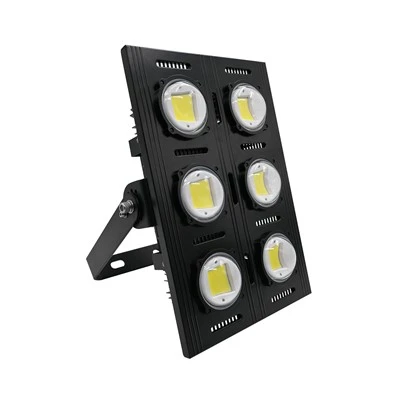
JR Lighting's JR506 high-power LED floodlight delivers up to 1500W of power and a luminous efficacy of 150 lm/W. It features premium light sources and drivers that offer robust surge protection and intelligent dimming capabilities (1-10V/DALI 2.0). The die-cast aluminum housing, paired with high-strength tempered glass, ensures corrosion and rust resistance; the unit boasts an IK08 impact rating and excellent thermal management, making it perfectly suited for coastal locations and extreme operating temperatures ranging from -35°C to 50°C. It offers a wide range of beam angles-from 10° to 90°-as well as professional asymmetric multi-angle light distribution. Backed by a 5-year warranty and a comprehensive suite of authoritative international certifications (including UL, ETL, DLC, TUV, CB, ENEC, CE, SAA, FCC, RoHS, and CQC), it is the premier choice for high-end stadium and industrial lighting applications!
Frequently Asked Questions (FAQ)
Q1: Why must stadium lights have a CRI of 90 or higher?
A: Primarily to meet the requirements of 4K/8K high-definition television broadcasting. A CRI of 90 or higher accurately renders athletes' skin tones, team uniform colors, and the texture of the playing surface, preventing color shifts or dull, distorted images during ultra-high-definition filming and slow-motion replays.
Q2: What are the practical benefits of high CRI for athletes and referees?
A: It enhances the contrast and visibility of fast-moving objects, helping athletes track the ball's trajectory more precisely and reducing visual fatigue, while also lowering the likelihood of officiating errors.
Q3: A CRI of 80 suffices for standard training grounds; why do international venues require 90 or higher?
A: Because international sports organizations-such as FIFA and the IOC-have strict compliance requirements for broadcast-quality events. Meeting the CRI 90+ standard is essential for hosting top-tier international competitions and commercial broadcasts, avoiding the need for costly retrofitting later due to non-compliance.
Q4: Does a CRI of 90+ result in higher power consumption or reduced brightness?
A: Modern professional LED technology has resolved this issue. Stadium lights with a CRI of 90+ that utilize high-quality chips can still maintain a high luminous efficacy of over 130 lm/W, ensuring superior color rendering while remaining energy-efficient.
Conclusion
Stadium lights with a CRI of 90+ do more than simply provide high-intensity illumination; they solve the complex challenge of accurate color rendering. They serve as critical infrastructure linking on-field athletic performance, high-end television broadcasting, and the realization of commercial value. For any stadium hosting professional competitions or high-profile broadcasts, adopting a professional lighting solution with a CRI of 90 or higher is essential to ensuring the quality of the event and the spectator experience.