
LED High Bay vs Metal Halide
Aug 27, 2026
Introduction
In industrial plants, logistics warehouses, and large-scale workshops, lighting systems typically account for 18% to 35% of a building's total operational electricity consumption. For a long time, many older facilities have relied on high-intensity discharge (HID) lamps, with metal halide lamps being the most common type.

Driven by breakthroughs in the luminous efficacy of high-power LED chips and advancements in thermal management technology, high-bay LED lights are rapidly replacing traditional metal halide lamps. This article presents a systematic, quantitative comparison of the two technologies, focusing on physical performance parameters, energy conversion efficiency, and actual operational costs.
Comparison of Key Parameters and Physical Properties
The table below compares the key technical specifications of a standard 400W metal-halide lamp system with a 150W high-efficiency LED high-bay light matched to the same illuminance requirements:
|
Physical/Electrical Specifications |
Traditional Metal Halide Lamps (MH) |
LED Industrial and Mining Lights (High Bay) |
Engineering Impact Difference Analysis |
|
System Luminous Efficiency |
60 – 80 lm/W |
140 – 180 lm/W |
LEDs save over 60% on electricity for the same lumens. |
|
Rated System Power |
400W + 45W (ballast losses) |
150W (Integrated High-Efficiency Driver) |
The measured power reduction of a single lamp was 295W. |
|
Cold/Hot Start Time |
5-15 minutes preheating time |
< 0.1 seconds (on and off instantly) |
LEDs can be seamlessly integrated into sensors and dimming systems. |
|
L70 Rated Life |
8,000 – 12,000 hours |
50,000 – 100,000 hours |
LED lifespan extended by nearly 5–8 times |
|
First Year Light Decay Rate |
25% – 40% |
< 3% |
Metal halide lamps experience severe illuminance degradation after one year of use. |
|
Color Rendering Index (Ra) |
60 – 65 (Significant color cast) |
Ra ≥ 80 / Ra ≥ 90 |
High color rendering reduces worker fatigue and safety hazards |
|
Heat Dissipation Ratio |
~75% of the energy is converted into heat. |
~30% of the energy is converted into heat. |
Reduce the cooling load of factory air conditioning in summer |
In-Depth Analysis: Four Key Technical Advantages of LEDs Replacing Metal-Halide Lamps
Electro-optical Conversion Efficiency and Directional Utilization Efficiency
Metal halide lamps have spherical or tubular light sources that radiate light in all 360° directions. They must rely on reflectors to project the light downwards, and the light loss during the reflection process can be as high as 30%–40%.
LEDs are solid-state surface light sources, and their emission angle can be precisely controlled by secondary optical lenses (such as 60°, 90°, 120°), with an effective luminous flux utilization rate of nearly 90%. Therefore, a 150W LED industrial and mining lamp can fully meet or even exceed the effective ground illuminance (Lux) of a 400W metal halide lamp.
Thermal Control and Environmental Adaptability
Metal halide lamps operate at temperatures as high as 800℃–1000℃ at the center of the discharge tube. These extremely high surface temperatures cause the lamp materials to age rapidly, and a large amount of radiant heat is directly projected onto the work area. LEDs, on the other hand, use die-cast aluminum alloy or copper tube heat sinks, and their junction temperature is typically controlled below 85℃. This not only results in higher system stability but also significantly reduces the energy consumption for air conditioning in summer workshops.
Lumen Depreciation Curve and Maintenance Costs
Metal halide lamps suffer from severe chemical light decay. After 3,000 hours of operation, their luminous flux typically decreases by more than 30%; in contrast, high-quality LED industrial and mining lamps, tested using the LM-80 standard, generally exhibit a light decay of less than 3% after 10,000 hours of continuous operation. The high frequency of metal halide lamp failure means that factories frequently need to use scissor lifts or scaffolding to replace bulbs, and the labor costs and downtime losses from working at heights often exceed the price of the bulbs themselves.
Quantitative Calculation of Economic Viability and Return on Investment (ROI)
Take, for example, a medium-sized assembly workshop equipped with 100 400W metal-halide lamps; assuming they operate for 16 hours a day, 365 days a year, and calculating industrial electricity costs at 0.85 RMB/kWh:
Before Retrofit (Metal-Halide Lamp System):
- Power consumption per lamp = 400W (bulb) + 45W (ballast loss) = 445W = 0.445kW
- Total annual electricity consumption = 100 × 0.445 kW × 16 h/day × 365 days = 259,880 kWh
- Annual operating electricity cost = 259,880 × 0.85 = 220,898 yuan
After Modification (Replaced with 150W LED High-Bay Lights):
- Power consumption per lamp = 150 W = 0.15 kW
- Total annual electricity consumption = 100 × 0.15 × 16 h/day × 365 days = 87,600 kWh
- Annual operating electricity cost = 87,600 × 0.85 = 74,460 yuan
Annual Direct Economic Benefit:
- Annual electricity savings: 220,898 - 74,460 = 146,438 yuan (electricity saving rate of 66.3%)
- Annual maintenance savings: approximately 15,000 yuan (based on the annual replacement of 30 metal halide lamps and labor costs for high-altitude operations).
- Total annual cost savings: 161,438 yuan
Assuming the cost of purchasing and installing a single high-quality 150W LED industrial and mining lamp is 350 yuan, the total investment is 100 × 350 = 35,000 yuan.
- Static investment payback period: 35,000 / 161,438 ≈ 0.217 years (approximately 2.6 months). That is, the system enters the pure profit stage starting from the third month after the renovation is completed.
Recommendations for Replacement Selection and Engineering Implementation
Reference for Selecting Replacement Power Ratings
- It is recommended to directly replace the 250W metal halide lamp with an 80W – 100W LED industrial lamp (installation height 4–6 meters).
- It is recommended to directly replace the 400W metal halide lamp with a 150W – 200W LED industrial lamp (installation height 6–9 meters).
- It is recommended to directly replace the 1000W metal halide lamp with a 300W-400W LED industrial lamp (for installation heights of 10 meters or more).
Considerations for Industrial Equipment Selection
- Power supply quality: The power supply is the core bottleneck of LED industrial and mining lamps in terms of lifespan. Prioritize branded power supplies with overvoltage, overcurrent, and overtemperature protection and a power factor (PF) > 0.95 (such as MeanWell, Philips, etc.).
- Lens angle matching: For narrow and deep factory buildings (height > 9 meters), 60° or 90° light-emitting angle lenses should be selected to concentrate the light beam; for open and low workshops (height < 6 meters), 120° astigmatic lenses should be selected to improve the uniformity of illumination.
- Protection rating (IP/IK): In dusty or humid workshops (such as textile and machining workshops), lighting fixtures must meet the dustproof and waterproof rating of IP65 or above and the mechanical shock resistance rating of IK08 or above.

Product Recommendations
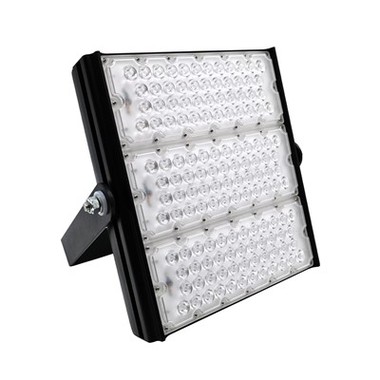
JR Lighting's HL01 LED high-bay light utilizes high-transmittance ultra-white tempered glass and imported high-brightness chips, achieving 50% energy savings compared to metal halide lamps and providing stable, efficient constant-current output. Its biggest highlight is the anti-glare treatment on the lampshade, with a UGR <19. high-temperature resistance, and UV protection, boasting both IP65 and IK09 high-protection ratings. With a wide power range of 80W to 250W, it is an ideal choice for lighting large spaces in industrial plants, warehouses, and shopping malls.
Frequently Asked Questions (FAQ)
Q1: Can a 150W LED high-bay light really replace a 400W metal-halide lamp?
A: Absolutely. Metal-halide lamps have a luminous efficacy of only about 70 lm/W and consume 455W of power when the ballast is included; in contrast, LEDs offer an efficacy exceeding 140 lm/W. A 150W LED light can provide equivalent or even superior effective illumination while saving over 65% on electricity.
Q2: How do they differ in terms of startup speed and smart control capabilities?
A: LEDs turn on instantly and support smart dimming and sensor controls. Metal-halide lamps require a 3- to 15-minute warm-up period to reach full brightness; if power is interrupted, they must cool down for several minutes before they can be reignited.
Q3: What is the difference in lifespan and maintenance costs between the two?
A: Metal-halide lamps have a lifespan of only about 10,000 hours and suffer from rapid light output degradation, necessitating frequent replacement every 1 to 2 years. LEDs last between 50,000 and 100,000 hours with minimal light degradation, ensuring over five years of operation without the need for high-altitude maintenance.
Q4: How long does it take for a factory to recoup the cost of switching to LED high-bay lights?
A: In industrial settings, the investment cost is typically recovered within 6 to 18 months through electricity savings; subsequent savings on electricity and maintenance represent pure profit.
Summary
When considering overall luminous efficacy, lumen depreciation, control responsiveness, and maintenance costs, there are no longer any technical or economic barriers to replacing metal-halide lamps with LED high-bay lights. For industrial facilities with long operating hours, the sooner the LED retrofit is completed, the more significant the accumulated cost-saving advantages will be.