
What Certifications Matter for Industrial LED Lighting Buyers?
Aug 25, 2026
Introduction
Industrial environments are typically characterized by high levels of dust, heat, and humidity, as well as intense vibration and even flammable or explosive hazards. In such settings, the procurement of lighting equipment involves more than just illumination performance; it directly impacts project acceptance, operational safety, eligibility for electricity subsidies, and long-term maintenance costs.

For B2B procurement decision-makers-such as engineering directors, facility managers, and procurement managers-certifications serve as the primary basis for evaluating the quality and regulatory compliance of a supplier's products.
Basic Electrical Safety Certification: Entry Thresholds and Legal Compliance
Electrical safety certification is a statutory baseline requirement for market entry and project acceptance. If uncertified lighting fixtures cause a fire or workplace accident, the enterprise faces the risk of insurance claim denial and legal liability.
North American Market (NRTL Certification System):
- UL certification: The focus is on verifying UL 1598 (safety standard for fixed lighting fixtures) and UL 8750 (safety requirements for LED equipment).
- ETL certification: issued by Intertek Testing. ETL and UL both belong to the Nationally Recognized Laboratories (NRTL) system in the United States, follow the same testing standards, and have completely equal legal effect.
European and International Markets:
- CE certification: A mandatory access directive for the European market, which must cover both LVD (Low Voltage Directive 2014/35/EU) and EMC (Electromagnetic Compatibility Directive 2014/30/EU) .
- CB System: An international certification mutual recognition system based on IEC standards, which allows CB test reports to be quickly converted into local safety certifications in multiple countries and regions.
Energy Efficiency and Performance Certification: Return on Investment and Operational Subsidies
Energy efficiency certification directly impacts the electricity costs of lighting fixtures and determines eligibility for financial subsidies from the government or utility companies.
DLC Certification:
- The standard for evaluating the performance of commercial and industrial lighting in North America. It is divided into two levels: Standard and Premium . Premium has higher requirements for luminous efficacy (lm/W) and light decay control.
- Products that have passed DLC certification can apply for electricity rebates from North American power companies (such as PG&E and Duke Energy) , which can significantly shorten the return on investment (ROI) of equipment.
Standards for Degradation and Lifespan Prediction:
- LM-79: A standard photoelectric test report for evaluating the luminous flux, power, luminous efficacy, and color rendering index of a whole lamp.
- LM-80 / TM-21: LM-80 provides actual light decay data of LED light sources at specific temperatures; TM-21 is a mathematical estimation standard that uses LM-80 data to predict the long-term lifespan of luminaires (such as L70, L90).
Certification for Protection in Special Environments: Ensuring Reliability in Harsh Operating Conditions
For specialized industrial workshops, equipment must possess the corresponding protective, explosion-proof, or sanitary certifications.
|
Certification Typee |
Standard/Grade |
Applicable Industrial Scenarios |
Core Values |
|
IP protection level |
IP65 / IP66 / IP69K |
High-dust, outdoor, high-pressure water gun washing areas (such as food processing areas). |
Preventing dust intrusion and short circuits caused by high-pressure water spray |
|
IK Impact Resistance Rating |
IK08 - IK10 |
Heavy industrial workshops, high-altitude hoisting, and mechanical vibration environments |
Ensure the casing is impact-resistant (IK10 can withstand 20 Joules of impact force). |
|
Explosion-proof Certification |
ATEX (Europe) / IECEx (International) / HazLoc (North America) |
Chemical plants, oil refineries, flour mills, mines and other flammable and explosive hazardous locations |
Isolate electrical sparks to prevent ignition of external gases or dust. |
|
NSF Certification |
NSF/ANSI 2 (Sanitation Standard) |
Food processing and pharmaceutical workshops |
Non-toxic material, smooth and easy to clean, no risk of peeling |
Electromagnetic Compatibility and Environmental Compliance
- FCC/EMC certification: Limits electromagnetic interference (EMI) generated by lighting switch power supplies. In automated workshops, drivers that have not passed EMC certification may cause nearby PLC controllers to malfunction, sensor values to drift, or wireless communication to be interrupted.
- RoHS/REACH directives restrict the use of hazardous substances such as lead, mercury, and cadmium, ensuring that equipment complies with environmental regulations and supply chain ESG compliance requirements.

Product Recommendations
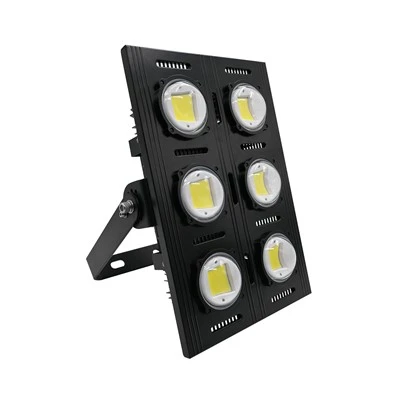
JR Lighting's JR506 high-power LED floodlight delivers up to 1500W of power and a luminous efficacy of 150 lm/W. It features premium light sources and drivers that offer robust lightning protection and intelligent dimming capabilities (1-10V/DALI 2.0). The die-cast aluminum housing, paired with high-strength tempered glass, ensures corrosion and rust resistance; the unit boasts an IK08 impact rating and excellent thermal management, making it perfectly suited for coastal regions and extreme environments ranging from -35°C to 50°C. It offers a wide range of beam angles (10°to 90°) as well as professional asymmetric multi-angle light distribution. Backed by a 5-year warranty and a comprehensive suite of authoritative international certifications, which including UL, ETL, DLC, TUV, CB, ENEC, CE, SAA, FCC, RoHS, and CQC. So that it is the premier choice for high-end stadium and industrial lighting applications.
Frequently Asked Questions (FAQ)
Q1: What mandatory certifications are required to export industrial LED lighting to North America, the EU, and China?
A: North America requires UL or ETL certification (electrical safety) and FCC certification (electromagnetic compatibility); the EU requires the CE mark (covering LVD and EMC directives) and RoHS environmental certification; and China requires CCC mandatory certification.
Q2: Why is applying for DLC certification essential for selling industrial LED lighting in North America?
A: Although DLC is a voluntary certification, it serves as a mandatory prerequisite for major North American utility companies to issue substantial energy rebates and is a standard requirement for procurement tenders for most industrial plants and warehouses.
Q3: What is the difference between the IP protection rating and explosion-proof certification (Ex) for industrial lighting?
A: IP ratings (e.g., IP65/IP66) protect the fixture against the ingress of dust and water; explosion-proof certifications (e.g., ATEX/IECEx) ensure the fixture does not trigger an explosion of external flammable gases or dust caused by internal electrical sparks.
Q4: What are the key tests performed for UL or CE certification of industrial LED lighting?
A: Core tests include temperature rise testing (evaluating heat dissipation safety under prolonged high-load operation), dielectric withstand/insulation testing (preventing leakage and electrical breakdown), ground continuity checks, and electromagnetic interference (EMC/EMI) testing.
Conclusion
For B2B buyers, purchasing industrial LED lights is by no means a one-off expense, but rather a fixed-asset investment spanning 5 to 10 years. Safety certifications establish the baseline, energy efficiency certifications yield significant cost savings, and environmental certifications determine product lifespan. Requesting a couple of extra reports and taking the time to verify model numbers in a database ensures smooth, efficient factory operations for years to come!