
How to Match Light Tower LED Power with Generator Capacity
Oct 29, 2026
Introduction
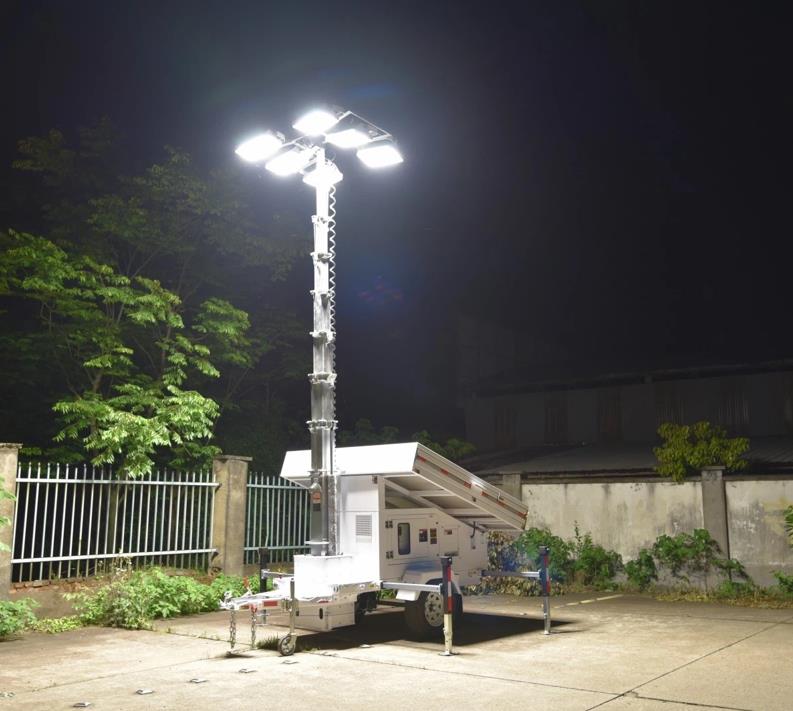
Mobile light towers are critical equipment across construction sites, mining operations, roadwork, and disaster relief zones. However, engineers and fleet managers often face a common sizing dilemma: under-sizing the generator leads to nuisance circuit tripping, while over-sizing causes unnecessary fuel consumption and engine damage.
How do you correctly match the total wattage of LED light heads with generator capacity? This guide breaks down the core technical calculations and sizing principles.
Technical Factors Governing Generator Sizing
Matching LED power to a generator requires more than comparing nameplate ratings. Four key variables dictate proper system sizing:
Prime Power vs. Standby Power:
Always size LED loads based on the generator's Prime (Continuous) Power rating, not its Standby (Peak) rating, as light towers typically operate continuously for 8 to 12+ hours per shift.
Power Factor (PF) Conversion:
Generators are often rated in kilovolt-amperes (kVA). To determine the actual usable output in kilowatts (kW), use the standard industrial power factor formula:
kW = kVA × 0.8 (PF)
LED Driver Inrush Current:
Although LEDs consume significantly less energy during operation than legacy Metal Halide lamps, their electronic drivers draw a momentary high peak inrush current during startup.
Auxiliary Power Demands:
The engine-generator set must also power secondary loads, including electric/hydraulic mast lifting motors, control panels, onboard battery chargers, and auxiliary power outlets used for site power tools.
Sizing Formula & Application Matrix
To optimize fuel efficiency and prevent premature component failure, the total electrical demand should target 70% to 80% of the generator's continuous capacity.
Calculation Formula:
Required Generator Output (kW) = Total LED Wattage (kW) + Auxiliary Load (kW) / Target Load Factor (0.7 to 0.8) × Power Factor (0.8)
Quick Reference Matching Guide:
| Total LED Power | Recommended Generator Prime Output | Primary Applications |
| 400W – 600W (e.g., 4 x 100W/150W) | 1.0 kW – 1.5 kW | Compact solar/diesel hybrid light towers |
| 1200W – 1600W (e.g., 4 x 300W/400W) | 2.5 kW – 3.5 kW | Standard construction sites & roadway maintenance |
| 2400W – 3200W+ (e.g., 6 x 400W/500W) | 5.0 kW – 6.5 kW | Heavy mining yards, stadium venues, emergency response |
Critical Sizing Errors to Avoid
Preventing "Wet Stacking" from Underloading:
Running a diesel generator below 30% of its rated capacity leads to incomplete fuel combustion. This causes unburnt fuel and carbon deposits to accumulate in the exhaust system, causing severe engine damage over time.
Factoring in Environmental Derating:
Generator output decreases at high altitudes and ambient temperatures (typically losing ~3% output per 1,000 feet of elevation). Always apply a derating factor when operating under extreme environmental conditions.
Voltage Regulation & Driver Longevity:
Poor quality generators with unstable AVR (Automatic Voltage Regulator) systems generate harmonic distortions that reduce the lifespan of sensitive LED drivers.

Recommended Products
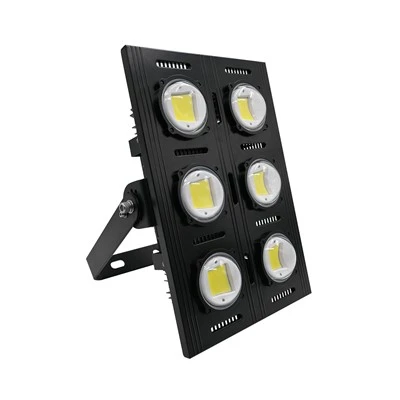
The IP66 LED Flood Light (Model: JR313) is available in 300W, 400W, and 500W with an efficacy of 150Lm/W, supporting AC100-277V/DC24V/DC48V voltages. Featuring a hollow laser-processed main body for superior dust-free air-flow cooling, 60°/90° beam angles, and high CRI options, it delivers durable, high-efficiency illumination tailored for demanding outdoor environments.
Frequently Asked Questions (FAQ)
Q1: Why shouldn't a mobile light tower's total LED wattage match the generator capacity on a 1:1 ratio?
A: Generator sizing must account for power factor conversions (typically 0.8 PF for industrial units), momentary LED driver inrush currents during startup, and auxiliary loads such as mast-lifting motors or external tool outlets. To ensure stable operation and prevent trips, total LED wattage should safely occupy 70% to 80% of the generator's continuous prime power rating.
Q2: How do you calculate the required continuous generator output (kW) for a mobile light tower?
A: Use the standard sizing formula: Required Generator kW = [Total LED Wattage (kW)} + Auxiliary Load (kW)] / [Target Load Factor (0.7–0.8) × Power Factor (0.8)]. For example, a standard setup with 1.2kW of LED floodlights typically requires a 2.5kW to 3.5kW continuous output generator to maintain an optimal 75% load factor.
Q3: What are the risks of over-sizing the generator for an LED light tower?
A: Running an oversized generator at a low load (under 30% of its rated capacity) causes "wet stacking" in diesel engines. This phenomenon results from incomplete fuel combustion, leading to heavy carbon buildup in the cylinders and exhaust system, loss of engine power, and premature component degradation.
Q4: How do high altitudes and extreme ambient temperatures affect light tower generator matching?
A: Environmental derating must be factored into high-altitude or high-temperature deployments. Because diesel generators typically lose roughly 3% of their output capacity per 1,000 feet of elevation or per 5°C above standard thresholds, you should oversize the generator by 10% to 20% to prevent unexpected overload trips in harsh climates.
Summary
Properly sizing your mobile light tower's generator requires balancing power factor conversions, startup inrush currents, and ideal engine load ratios. Maintaining a 20% to 30% safety margin ensures reliable night operations and maximum fuel economy.
Looking to retrofit your lighting fleet or customize high-efficiency LED floodlights for mobile towers? Contact our engineering team for technical specifications and Dialux lighting simulations.