


COB (Chip-On-Board) Vs. SMD (Surface-Mounted Device) LED Chips For Industrial Lighting Selection A Technical Guide
Apr 16, 2026
Whether for warehouses, factories, assembly lines, or outdoor yards, the choice of LED chip technology is critical! While both COB and SMD offer high efficiency compared to traditional lighting, they serve distinctly different purposes in the industrial sector.
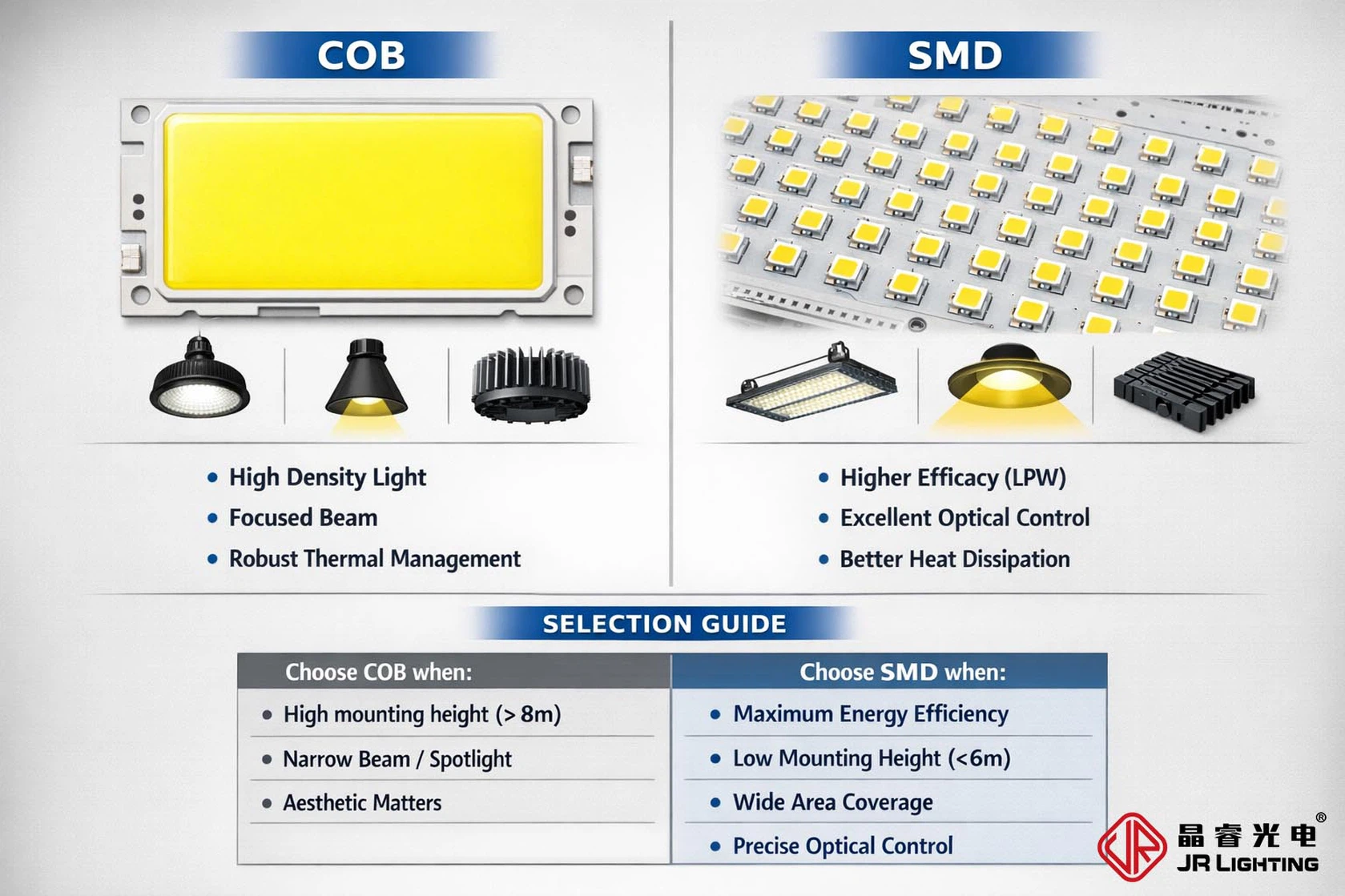
As regards application scenarios, the COB type is best for High Bay lights, Floodlights, and applications requiring high-density light from a small source.
Advantages:
✅ High Luminous Density: COB chips produce a high lumen output from a very small surface area. This makes them ideal for creating focused, intense beams.
✅ Concise Aesthetics: Because the light comes from a single "panel" rather than dots, COB fixtures offer a glare-free, uniform appearance without the "dotted" reflection often seen in SMD fixtures.
✅ Simplified Design: Requires fewer components (no need for dozens of individual diodes), which can lead to more compact fixture designs.
Disadvantages:
❌ Thermal Problem: Because the chips are densely packed together, COB LEDs generate significant heat in a concentrated area. They require high-quality heat sinks (often larger or with active cooling fans) to prevent overheating and lumen depreciation.
❌ Lower Efficacy: In high-power industrial applications, high-end SMD setups often achieve higher lumens per watt than COB, meaning SMD can be more energy-efficient.
❌ Repairability: If a COB chip fails, the entire fixture or module usually needs to be replaced, as individual chip repair is not feasible.
On the other hand, the SMD type is best for linear high bays, parking lot lights, and applications requiring wide, uniform coverage.
Advantages:
✅ Superior Efficacy: Modern SMD chips are the most energy-efficient LEDs available, maximizing energy savings.
✅ Better Heat Dissipation: Because the diodes are spread out across the PCB, heat is distributed over a larger area. This typically results in a longer lifespan and lower operating temperatures compared to COB.
✅ Optical Versatility: SMD fixtures can be easily fitted with different lenses (narrow spot) to precisely control the beam angle, making them suitable for applications from narrow aisles to large open areas.
✅ Durability: If a single SMD chip fails, the rest of the fixture continues to operate. In some high-end fixtures, individual modules can be replaced.
Disadvantages:
❌ Glare and Shadows: Without proper diffusers, the individual dots of light can create harsh shadows and a "dotted" reflection on glossy floors (common in warehouses).
❌ Complex Optics: To create a uniform wash of light, SMD fixtures often require frosted lenses or diffusers, which can slightly reduce overall light output.


