
Key Indicators for Port Lighting Requirements
Aug 14, 2026
Introduction
In the daily operations of ports and docks, lighting systems often play the role of an "invisible safety net." As a heavy logistics hub that operates 24/7 , the port environment is extremely harsh-high salt spray, strong storms, severe vibrations from heavy machinery, and high-risk operations at heights all combined.

If ordinary industrial lighting fixtures from factories or logistics warehouses are directly used in the lighting selection, it will not only lead to rapid light decay and frequent damage to the fixtures, but may even cause serious safety accidents during nighttime operations. To create a high-standard, high-reliability port lighting system, the following three core technical indicators must be strictly controlled.
Illuminance and Light Quality Requirements: Balancing "Clear Visibility" with "Glare Prevention"
The port's operating area is vast and complex, ranging from tens of meters high container stacks to the busy dock front, requiring extremely high precision in lighting.
Regional Illuminance Standards and Uniformity
According to the International Commission on Illumination (CIE) and relevant national port lighting standards (such as GB 50034 / EN 12464-2), the illuminance (Lux) and uniformity (U_0) of different work areas are strictly defined:
|
Work Area |
Recommended Average Illuminance (Eav) |
Illuminance Uniformity (U0) |
Key Technology Requirements |
|
Container Yard |
20 – 30 Lux |
≥ 0.4 |
Narrow/medium beam distribution, shadows penetrating the gaps between tall shipping containers |
|
Quayside |
50 – 100 Lux |
≥ 0.5 |
High-brightness color rendering ensures safety for cables, hooks, and human-machine interaction. |
|
Gate Area |
30 – 50 Lux |
≥ 0.4 |
Flicker-free illumination, combined with OCR automatic license plate/box number recognition |
|
Hazardous Materials and Special Cargo Warehouse Area |
50 – 100 Lux |
≥ 0.5 |
Stringent explosion protection, meets explosion-proof rating certification |
Strictly control glare
In port environments, glare is an extremely dangerous "safety killer".
- Visibility during high-altitude operations : Operators of quay cranes (STS) and gantry cranes (RTG/RMG) are located tens of meters in the air. If the high-mast lights or floodlights produce direct glare, it can cause visual fatigue or even short-term blindness to the operators, which can easily lead to lifting collisions.
- Light distribution design : Port lights must adopt polarized or asymmetrical light distribution design to precisely cut off the light and project it onto the target work area, ensuring the brightness of the work surface while cutting off stray light directed towards the high-altitude cockpit and the crew's field of vision.
Color rendering properties and luminous efficacy
- Color Rendering Index (CRI) : Recommended CRI ≥ 70 (CRI recommended for dangerous goods areas or customs inspection areas) ≥ 80). High color rendering helps operators quickly identify container hazard labels, safety warning signs, and vehicle license plates.
- Luminous efficiency : Port lighting fixtures typically require high power (400W–1200W) to operate for extended periods. Using high-efficiency LEDs with a luminous efficiency of 140 lm/W or higher can significantly reduce the annual electricity costs for ports.
Superior environmental protection: Withstanding harsh marine climates
The port is located at the junction of land and sea, and the lighting fixtures need to directly face extreme natural environments such as high salt spray, high humidity, and strong storms.
Salt Spray & Corrosion Resistance Rating :
The high concentration of salt spray along the coast has a strong chemical corrosive effect on metal casings. The aluminum alloy casings of port lighting fixtures must undergo special anodizing and high-pressure electrostatic spraying treatments, achieving a corrosion resistance rating of WF2 or higher, and passing a salt spray test of over 1000 hours (e.g., ASTM B117 standard). Critical connectors and fasteners must be made of 316 stainless steel.
IP protection level (Ingress Protection) :
Port high-mast lights and quay crane lights must withstand strong rain from sea winds and waves crashing against the dock. The overall protection rating of the lights must reach IP66 or IP67 to ensure dust and water resistance and prevent moisture from entering the internal cavity.
Earthquake and wind resistance design :
- Wind resistance : The wind resistance area (EPA) of the luminaires installed on 25–40 meter high poles must be calculated with precision and the structure must be able to withstand the continuous impact of strong storms of level 12 or above (wind speed of 35 m/s or above) .
- Seismic-resistant structure : Lighting fixtures installed on quay cranes (STS) and yard cranes (RTG) undergo thousands of frequent starts and stops and severe vibrations every day along with the mechanical structure. The lighting fixtures not only need to meet the IK10 mechanical impact resistance rating , but their internal drive power supply and chip substrate must also be encapsulated with shock-resistant silicone and equipped with fall protection ropes to prevent components from loosening and falling off due to fatigue vibration.
Thermal Management and Electrical Stability: Ensuring 24/7 High Reliability
The cost of maintaining a lighting system in a port often far exceeds the purchase cost of the lights themselves, due to maintenance expenses (renting aerial work platforms and losses from downtime) . Therefore, the stability and lifespan of the lights are of paramount importance.
Thermal Management
The degradation of LED chips and the lifespan of the driver power supply are directly dependent on the operating temperature. Due to the extremely high power of port floodlights, it is necessary to use aerospace-grade aluminum or copper pipe heat dissipation technology with high thermal conductivity, coupled with a reasonable air convection channel design, to control the junction temperature within a safe range, ensuring that the luminaire still has an ultra-long lifespan of 50,000–100,000 hours (L70/B10) even in high temperature and high humidity environments.
Lightning and surge protection
Port high-mast lights, erected in open coastal areas, are highly susceptible to lightning strikes. Furthermore, heavy inductive loads in the port (such as the starting and stopping of high-power motors) can cause frequent voltage surges in the power grid.
- Port lighting systems must be equipped with independent 10kV/20kA surge protectors (SPDs) .
- The power supply must have a wide voltage input range (such as 90–305V or 240–480V) to avoid power grid fluctuations causing the lamps to burn out or flicker.

Product Recommendations
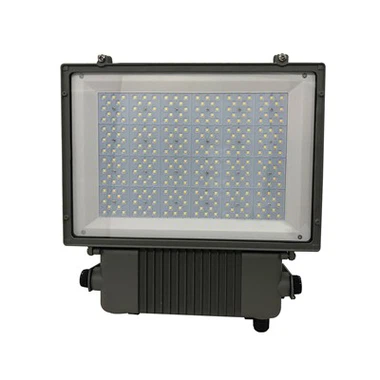
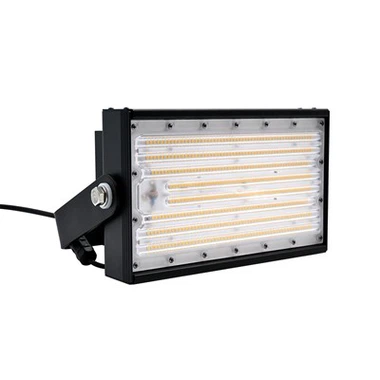
To meet these demanding marine lighting requirements, selecting a top-tier LED floodlight manufacturer is crucial. The JR328 series heavy-duty floodlights offer the ultimate solution to the vulnerability of coastal environments. Featuring an innovative air-convection cooling chassis and robust multi-element silicone seals, these outdoor waterproof floodlight components not only boast certified IP67 water and dust protection but also IK09 impact resistance , sufficient to withstand severe mechanical impacts and harsh weather conditions.
This flagship series of waterproof LED floodlights features high-yield SMD 5050 chips with a luminous efficacy of up to 160 Lm/W, completely eliminating blind spots on docks and berths. Its snap-on lens matrix ensures structural integrity even under heavy machinery vibrations. Upgrade to this decisive IP67 LED floodlight system now to significantly reduce your maintenance costs and lock in long-term reliable marine operational performance.
Frequently Asked Questions (FAQ)
Q1: What are the illumination standards for different areas of the port?
A: 20-30 Lux is required for the storage yard, 50-150 Lux is required for the quay front and loading/unloading area, and 30-100 Lux is required for the main road and checkpoints with no flicker.
Q2: What are the mandatory protective requirements for lamps in a high-salt-fog marine environment?
A: The protection level must reach IP66/IP67 and IK09/IK10, and it must have a WF2 level or higher corrosion resistance and pass a salt spray test of more than 1000 hours.
Q3: Why is anti-glare emphasized in port lighting fixtures? How is it solved?
A: Direct glare can cause momentary blindness to crane operators and crew, leading to accidents. Polarized light distribution design must be used to accurately project light onto the work surface.
Q4: What benefits can be gained by upgrading traditional lighting fixtures to LED?
A: It can save 50%-70% of electricity, significantly reduce high-altitude maintenance costs by utilizing an ultra-long lifespan of over 50,000 hours, and achieve instant on/off within seconds.
Conclusion
In general, port lighting is not simply about "turning on the lights." It is a systematic engineering project that integrates optical light distribution control, material corrosion resistance mechanics, seismic structural design, and electrical surge protection .
Only by accurately grasping the above indicators during the planning and procurement stages can we build a solid safety barrier for the busy port at night while significantly reducing operational energy efficiency.