
2026 Professional Buying Guide for LED Floodlights
Aug 07, 2026
Introduction
LED floodlights are surface light source equipment, with a lighting angle of usually 90° -120°, and are used to cast light evenly over a large area. Unlike narrow-angle focused spotlights, when purchasing floodlights, you need to focus on luminous flux, heat dissipation performance, driving stability and protection indicators.
Selection Based on Key Technical Parameters
Luminous Flux (Lumens) and Luminous Efficacy (lm/W)
- Moving away from wattage: In the LED era, brightness should not be evaluated based on wattage (W); instead, it must be calculated using lumens (lm).
- Luminous efficacy benchmark: High-quality industrial or commercial-grade LED floodlights should achieve a luminous efficacy of ≥ 120 lm/W.
Correlated Color Temperature (CCT) and Color Rendering Index (CRI)
- 3000K (Warm White): Suitable for courtyards, landscapes, and leisure areas; minimizes environmental disruption caused by high blue-light levels.
- 4000K–4500K (Natural White): Suitable for sports fields, commercial building facades, and public walkways; provides high clarity and visual comfort.
- 5000K–6500K (Cool White): Suitable for security areas, parking lots, logistics parks, and factories; enhances nighttime visibility and warning effectiveness.
- Color Rendering Index (Ra): CRI ≥ 70 required for general sites; CRI ≥ 80 required for sports fields and commercial display areas.
Housing Material and Heat Dissipation Structure
- Material Standard: Must utilize ADC12 die-cast aluminum or high-thermal-conductivity aviation-grade aluminum for the housing; the use of engineering plastic housings is prohibited.
- Thermal Design: Evaluate the surface area of the rear heat-dissipation fins. Junction temperature control directly determines chip lifespan and lumen depreciation (L70 lifespan).
LED Driver and Electrical Safety
- Driver Solution: Prioritize the use of isolated constant-current LED drivers.
- Surge Protection: Outdoor luminaires must feature lightning/surge protection capabilities (surge rating of at least ≥ 4kV; industrial-grade applications recommend ≥ 6kV–10kV).
- Power Factor (PF): Must meet a PF of ≥ 0.95.
Protection Ratings (IP / IK)
- IP Rating: A minimum rating of IP65 (dust-tight and protected against low-pressure water jets) is required for outdoor environments; ratings of IP66 or IP67 are mandatory for areas subject to heavy rain, high humidity (such as coastal regions), or frequent cleaning.
- IK Rating: Areas at risk of strong external impacts (e.g., sports courts or low-level installations) must meet mechanical impact resistance standards of IK08 or higher.
Application Scenario Selection and Configuration Table
|
Application Scenarios |
Recommended Lumen Range |
Recommended Color Temperature (CCT) |
Protection Rating (IP) |
Optical/Additional Configuration Requirements |
|
Family Courtyard/Entrance Door |
1,500 - 3,000 lm |
3000K |
IP65 |
Wide beam angle (120°), anti-glare shield |
|
Garage Door/Security Protection |
3,000 - 5,000 lm |
5000 - 6500K |
IP65 |
Equipped with PIR human infrared/microwave radar sensor |
|
Outdoor Sports Courts |
15,000 - 40,000 lm |
4000 - 5000K |
IP66 |
CRI ≥ 80, surge protection ≥ 6 kV, asymmetric light distribution |
|
Industrial Plant area/Logistics Yard |
20,000 - 60,000+ lm |
5000K - 6500K |
IP66 / IP67 |
Heavy-duty die-cast aluminum fin heat dissipation, high power factor drive |

Product Recommendations
To withstand rigorous industrial operating conditions-such as extreme equipment vibration, high heat, or moisture ingress-high-standard lighting solutions require exceptionally robust hardware.
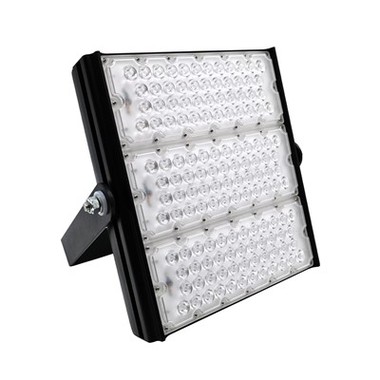
The JR309 series LED floodlights are engineered specifically for these demanding commercial and industrial environments. The series offers a wide power range from 50W to 600W and features high-efficacy SMD floodlight arrays, delivering a system luminous efficacy of up to 200 lm/W. Designed with customizable optical lenses (25°, 40°, 60°, and 90°) and incorporating a vibration-resistant arch-bridge structure alongside a dual-coupled IP67-rated housing, the JR309 ensures professional, reliable, and trouble-free lighting for ports, factories, and stadiums. This rugged design fundamentally resolves the industry's pain points associated with traditional, energy-intensive fixtures-namely frequent failures and high maintenance costs in harsh outdoor settings.
Frequently Asked Questions (FAQ)
Q1: How do you determine the required brightness and quantity of LED floodlights for industrial settings?
A: Industrial lighting should be evaluated based on lumens rather than wattage; individual fixtures often require an output of 15,000–50,000 lm. It is recommended to perform precise calculations using DIALux optical simulation software-factoring in site-specific illuminance requirements (e.g., 50–100 lux for walkways, 200–300 lux for precision tasks), mounting height, and beam angle-rather than relying on guesswork.
Q2: What IP and IK protection ratings are required for harsh industrial environments?
A: Standard indoor industrial areas typically require an IP65 rating, while outdoor storage yards or high-pressure wash-down zones require IP66 or IP67. Areas at risk of mechanical impact require IK08–IK10 ratings. Facilities such as chemical plants or coastal sites exposed to high salinity/salt spray also require anti-corrosion coatings and explosion-proof certification.
Q3: Why are the heat dissipation structure and driver power supply more critical than the chip itself in industrial floodlights?
A: If a chip operates at high power for extended periods with poor heat dissipation (i.e., lacking high-quality die-cast aluminum fins), it will suffer from severe lumen depreciation and a shortened lifespan. Furthermore, industrial power grids are prone to frequent voltage fluctuations and lightning strikes that can easily damage inferior power supplies; therefore, an isolated constant-current driver with surge protection (≥6kV) is essential to ensure stability.
Q4: What are the common mounting methods for industrial LED floodlights, and how should one choose?
A: Common methods include adjustable U-bracket or yoke mounts (suitable for walls and steel structures), pole-mount clamps or sleeves (suitable for high-mast poles), and eye-bolt or chain suspension (suitable for high-ceiling factory roofs). Mounting hardware should be verified in advance based on the specific characteristics of the installation site's mounting surface.
Conclusion
Selecting the right LED floodlight hinges on precisely matching technical specifications to the actual application scenario. Purchasing decisions should be guided by these principles: measuring brightness in lumens, matching color temperature to the setting, prioritizing die-cast aluminum heat dissipation and isolated drivers, and strictly adhering to IP and IK protection rating standards. Through scientifically configured parameters and proper installation angles, one can effectively enhance lighting quality and site safety while minimizing lumen depreciation, thereby ensuring both a long service life and high energy efficiency.