


Key Standards for Industrial Solar Street Lights
Oct 30, 2026
Introduction
Solar street lighting has become the premier choice for industrial parks, mining sites, logistics hubs, and highways due to its zero electricity costs, easy installation, and independence from grid infrastructure. However, industrial-grade applications require significantly higher reliability, brightness, and durability than residential or rural street lights.

System failures-such as pole collapses during storms, sudden light blackouts during rainy spells, or rapid battery degradation-are almost always caused by a failure to meet stringent engineering standards.
This guide outlines the critical standards across optics, solar components, structural integrity, and international certifications to ensure your project's long-term ROI.
Optical and Roadway Lighting Standards
An industrial solar street light must first function as a high-performance roadway luminaire.
- Illuminance and Uniformity (CJJ 45 / CIE Standards): For industrial main roads and logistics zones, average illuminance (Eav) should strictly meet 15 Lx - 30 Lx, with an illuminance uniformity (U0) greater than 0.4 to eliminate dark spots and harsh glare.
- CCT and Color Rendering Index (CRI): A Correlated Color Temperature (CCT) of 4000K to 5000K (Neutral/Cool White) is recommended to improve nighttime alertness and visibility. A CRI of ≥ 70 is required to accurately render colors for heavy machinery and vehicle operations.
- Luminous Efficacy & Ingress Protection: Industrial LED modules should offer high luminous efficiency (≥ 170 Lm/W). The luminaire fixture must carry an IP65 or IP67 rating for complete dust and water protection in extreme industrial environments.
Solar PV and Energy Storage System Standards
The operational lifespan of a solar street light relies heavily on the quality of its core power generation and storage components.
| Component | Industry Standard | Industrial Specification Requirement |
| Solar Panel (PV) | IEC 61215 / IEC 61730 | Monocrystalline silicon panels with efficiency ≥ 22%. Must feature Anti-PID properties and withstand high mechanical snow/wind loads. |
| Energy Storage Battery | IEC 62619 / UL 1973 | Lithium Iron Phosphate (LiFePO) is mandatory. Cycle life ≥ 2000 cycles (@80% DOD) with a wide operating temperature range (-20°C to +60°C). |
| MPPT Controller | CE-EMC / IEC 62093 | Maximum Power Point Tracking (MPPT) technology with tracking efficiency ≥ 99%. Integrated overcharge, over-discharge, short-circuit, and thermal protection. |
Structural Mechanics and Corrosion Resistance Standards
Industrial complexes are often built in open regions subject to severe winds and corrosive atmospheric conditions.
- Wind Resistance & Mechanical Calculation: Lighting poles must be engineered according to local maximum wind load calculations. Industrial-grade poles should be built to withstand Class 12+ typhoons/hurricanes (≥ 35 m/s). Flange plate thickness and gusset plate reinforcement must be verified through structural stress testing.
- Hot-Dip Galvanization (ISO 1461 / GB/T 13912): To prevent rust, steel poles must undergo internal and external hot-dip galvanization with a zinc coating thickness of 65 μm - 86 μm, complemented by an outdoor electrostatic powder coating. This ensures a corrosion-free lifespan of 15 to 20 years in coastal or high-sulfur industrial zones.
Electrical Safety and Global Certifications
For global engineering tenders and municipal procurement, certification compliance is non-negotiable:
- IEC 60598-1 / IEC 60598-2-3: Standard for general luminaire safety and specific requirements for road lighting fixtures.
- CE / RoHS Compliance: Mandatory European conformity for electrical safety and hazardous substance restriction.
- UL Standards (e.g., UL 1598 / UL 8800): Essential safety benchmarks for luminaires and electrical equipment entering North American markets.
- ISO 9001 & ISO 14001: Quality and environmental management systems verifying consistent manufacturing standards.
Installation Protocols and System Autonomy
Quality hardware requires compliant engineering on site:
- Autonomy Days (Rainy Day Backup): Industrial configurations must incorporate 3 to 7 days of continuous rainy day backup to guarantee 365-night uninterrupted lighting.
- Foundation & Lightning Protection: Concrete footings must meet at least C25/C30 compressive strength standards. The pole must be linked to a grounding grid with a resistance of ≤ 4 Ω to protect sensitive LED drivers and MPPT electronics against lightning surges.
Recommended Products
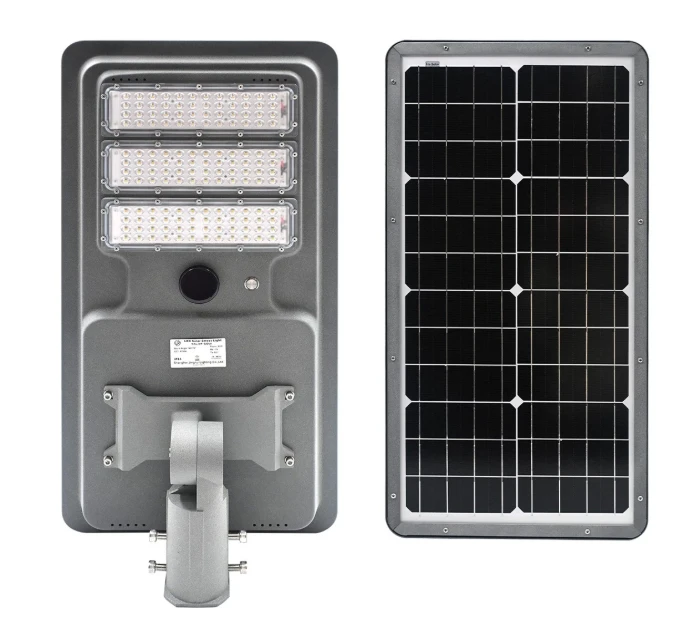
The SSL34 Integrated Solar Street Light is highly recommended. Designed with solar panels, LED sources, an MPPT controller, a LifePO4 battery, and human body induction, it offers 20W-30W power, 150 Lm/W light efficiency, and a wide temperature range of -20°C to +60°C. Featuring intelligent weather judgment, automatic power adjustment, and dual hardware-software charging protection with over 2,000 battery cycles, it perfectly meets industrial standards for high stability and longevity.
Frequently Asked Questions (FAQ)
Q1: What is the primary difference between industrial and residential solar street lights?
A: Industrial solar street lights use higher-spec IP65/IP67 luminaires, long-life LiFePO batteries (≥ 2000 cycles), and hot-dip galvanized poles engineered to withstand Class 12+ typhoons, ensuring 15–20 years of reliable operation in heavy-duty environments.
Q2: How do industrial solar street lights maintain lighting during long rainy periods?
A: They are engineered with a 3-to-7-day power autonomy backup and use intelligent MPPT controllers that automatically adjust power output during consecutive overcast days to guarantee uninterrupted nightly lighting.
Q3: Why is LiFePO preferred over Ternary Lithium for industrial solar lighting?
A: LiFePO batteries offer high thermal safety (no risk of explosion up to 800°C), an extended 8–10 year operational lifespan, and stable performance across extreme temperatures (-20°C to +60°C).
Q4: What key international certifications are required for industrial solar lighting tenders?
A: Major tenders mandate IEC 60598 for luminaires, IEC 61215/61730 for PV panels, IEC 62619/UL 1973 for batteries, along with CE, RoHS, UL, and ISO 9001 compliance.
Conclusion
When procuring industrial solar street lights, focusing solely on the upfront hardware cost is a risky strategy. Evaluating products based on international standard compliance and Total Cost of Ownership (TCO) ensures long-term operational stability and minimal maintenance expense.
Planning an outdoor lighting project for an industrial facility? Contact our application engineers today to receive custom DIALux lighting designs, technical compliance datasheets, and factory-direct quotations.


