
Complete Guide to LED Street Light Lightning Protection and Grounding
Nov 13, 2026
Introduction
Outdoor LED street lights operate in exposed, open environments-highways, bridges, industrial parks, and coastal roads-making them prime targets for lightning strikes and transient voltage surges. For municipalities, EPC contractors, and project developers, a single severe thunderstorm can trigger widespread driver failures, LED chip degradation, and costly maintenance callouts, severely impacting the project's Return on Investment (ROI).
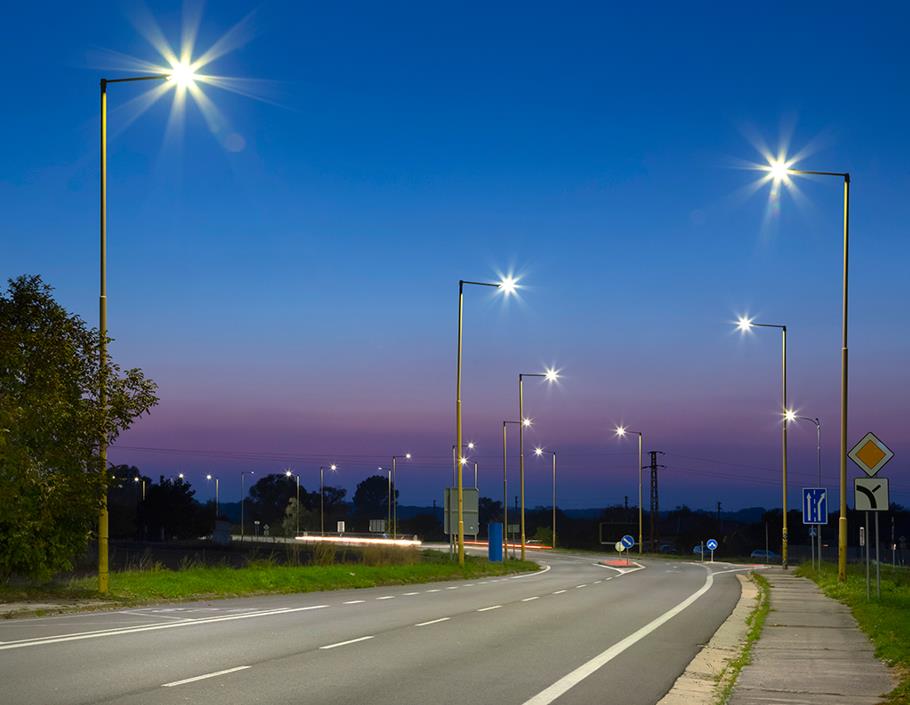
This engineering guide breaks down the mechanics of lightning damage, international surge protection standards, and field-proven grounding practices to ensure long-term reliability for commercial LED street lighting systems.
Why LED Street Lights Fail During Thunderstorms
Unlike traditional HID or sodium lamps, modern LED luminaires rely on sensitive semiconductor components and switch-mode power supplies. Lightning threatens these systems through three primary mechanisms:
- Direct Lightning Strikes: A direct hit to a metal light pole or overhead power line injects tens of thousands of amperes into the structure, causing immediate thermal destruction and physical damage.
- Induced Surges & Line Transients (Most Common): Even a cloud-to-ground strike miles away generates intense electromagnetic pulses (LEMP). These induce high-voltage surges-often exceeding 6kV to 20kV-along power distribution cables, traveling directly into the LED driver.
- Ground Potential Rise (GPR): When nearby grounding grids dissipate massive lightning currents into the earth, local soil voltage spikes instantaneously. Without proper equipotential bonding, this surge backs up through the ground wire into the luminaire, blowing out internal circuitry.
The Three-Tier Protection Architecture for Commercial LED Lighting
To comply with international standards such as IEC 61643-11, IEEE C62.41.2, and UL 1449, engineers implement a coordinated, multi-layered defense strategy:
Tier 1: External Lightning interception
- Air Terminals: For high-mast poles (15m–30m) or fixtures installed in high-keraunic (storm-prone) regions, a compact lightning rod at the pole apex intercepts direct strikes.
- Down Conductors: Galvanized steel poles with sufficient wall thickness (typically greater than 3.0mm) serve as robust, low-impedance down conductors to channel lightning currents safely toward the foundation.
Tier 2: Cascaded Surge Protection Devices (SPD)
A single surge protector is rarely enough to clamp extreme transients down to a safe level for LED drivers. A two-stage SPD cascade is the industry benchmark:
- Primary Protection (Feeder / Control Cabinet): Install a heavy-duty Type 1 or Type 2 SPD with a high nominal discharge current (In rated at 40kA to 80kA) inside the main street lighting distribution panel to divert the bulk of grid-borne surge energy.
- Secondary Protection (Luminaire / Pole Base): Equip each LED street light with a dedicated 10kV/10kA or 20kV/10kA SPD (preferably IP66/IP67 rated with thermal disconnect and end-of-life LED status indicators). This clamps residual voltage protection levels (Up) below 1.5kV, well within the dielectric withstand limit of industrial LED drivers.
Tier 3: Equipotential Bonding
All metallic components-including the luminaire housing, pole shaft, anchor bolts, cable armoring, and earth electrodes-must be electrically bonded together. Equipotential bonding eliminates dangerous voltage differentials during a surge event, preventing internal flashovers.
Field Installation Best Practices & Grounding Standards
Even top-tier SPDs will fail if the physical grounding installation is compromised. Follow these critical specifications during site deployment:
| Engineering Parameter | International Standard & Best Practice | Common Installation Mistakes to Avoid |
| Grounding Resistance | Maintain an earth resistance of ≤ 10Ω for standalone poles, and ≤ 1Ω when tied into a shared municipal grounding grid. | Failing to use ground enhancement materials (GEM) or deep-driven rods in rocky, sandy, or high-resistivity soils. |
| Earth Electrodes | Utilize foundation rebar cages bonded to anchor bolts, supplemented by hot-dip galvanized steel rods or copper-clad steel electrodes buried below the frost line (greater than 0.7m). | Using untreated steel rods that corrode rapidly in high-moisture or coastal high-salinity environments. |
| Exothermic Welding & Anti-Corrosion | Use exothermic welding or UL-listed brass/copper clamps for underground joints. Coat all welded seams with anti-corrosion bitumen or zinc-rich paint. | Relying on loose mechanical bolts underground or leaving weld slag uncoated, leading to high-resistance open circuits. |
| Pole Access Door Bonding | Connect the pole's removable inspection door to the main shaft using a dedicated yellow-green flexible copper strap (≥ 4mm² / 12 AWG). | Assuming metal hinges provide adequate grounding-paint and rust quickly insulate hinges, creating shock hazards. |
| SPD Lead Length | Keep SPD connecting wires as short and straight as possible-ideally under 0.5m (20 inches) total lead length-using Kelvin (V-wiring) connections where applicable. | Coiling excess wire inside the pole base, which adds parasitic inductance and doubles let-through voltage during fast transients. |
Preventive Maintenance & Inspection Protocol
SPDs are sacrificial components designed to absorb finite surge energy over their lifespan. Integrating lightning protection checks into routine O&M schedules prevents unexpected outages:
- Pre-Monsoon / Pre-Storm Audits: Inspect distribution panels and pole bases before peak storm seasons.
- Visual Status Verification: Check the mechanical or LED fault indicators on installed SPDs. A green indicator confirms active protection; a red or extinguished indicator signals that the Metal Oxide Varistor (MOV) has reached end-of-life and requires immediate replacement.
- Periodic Earth Testing: Use a clamp-on ground resistance tester annually to verify that soil resistance remains within spec and underground conductors have not suffered corrosion or theft.
Recommended Products
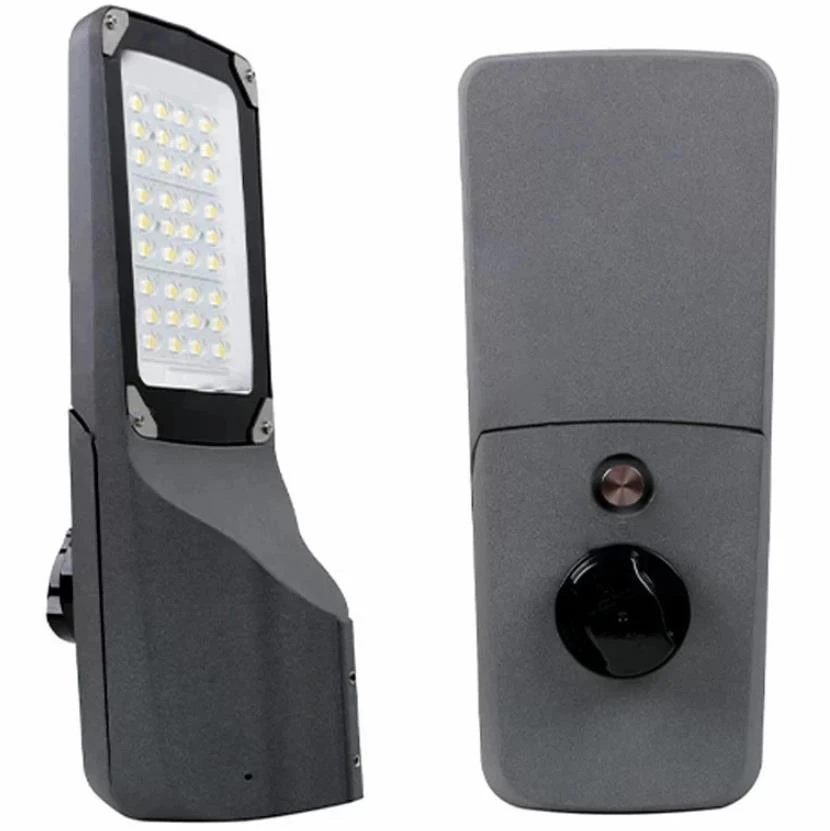
JR Lighting SL05 waterproof LED street light features a European die-cast design with IP66 rating and strong typhoon resistance. Offering 40W-150W power, 100-150 Lm/W efficiency, 3000K-6500K color temp, and -40°C~50°C range. It supports tool-free live maintenance and NEMA/ZHAGA smart interfaces for a cost-effective solution.
Frequently Asked Questions (FAQ)
Q1: What is the required grounding resistance for LED street lights?
A: Standalone LED street light poles require an earth grounding resistance of ≤ 10Ω (or ≤ 4Ω for major highways). When tied into a shared municipal or building grounding grid, the total resistance must be ≤ 1Ω.
Q2: Should a Surge Protection Device (SPD) be installed before or after the LED driver?
A: An SPD must always be installed before (on the AC input side of) the LED driver. This allows it to intercept high-voltage line transients and divert surge currents safely to ground before reaching the driver's circuitry.
Q3: What kV/kA rating is recommended for LED street light surge protection?
A: Commercial projects typically use a two-stage setup: a 40kA–80kA Type 1/Type 2 SPD inside the main feeder cabinet, paired with a 10kV/10kA or 20kV/10kA SPD (IEC 61643-11 / IEEE C62.41.2 compliant) inside each luminaire or pole base.
Q4: How do you know if an LED street light surge protector has failed?
A: Check the SPD's built-in status indicator during routine maintenance: a green flag or lit green LED confirms active protection, while a red flag or extinguished LED indicates the internal MOV has reached end-of-life and requires replacement.
Conclusion
Effective lightning protection and grounding are essential investments that safeguard outdoor LED lighting infrastructure from costly surge failures and public safety hazards. By combining low-resistance earth grounding (≤ 10Ω), solid equipotential bonding, and coordinated two-stage SPD protection, contractors and municipalities can dramatically extend luminaire lifespans and minimize long-term maintenance costs.