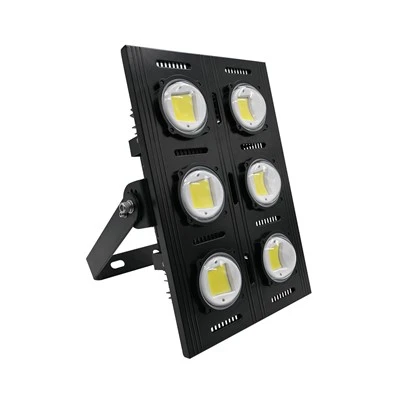

How many lumens should a flood light be?
Mar 03, 2026
Excerpt / Introduction:
I've been specifying commercial flood lights for more than 15 years. Warehouses, logistics parks, construction sites, even small stadium projects. And the question clients always ask is simple: How many lumens should a flood light be?
The honest answer? It depends. Not a marketing answer - a real engineering one. Lumens alone don't solve your lighting problem. Mounting height, beam angle, spacing, reflectance… these matter just as much, sometimes more.
In this article, I'll walk you through how we engineers actually decide lumen levels in commercial projects, with real numbers, data tables, and a few lessons learned the hard way.

First, Stop Looking at Watts
If you're still comparing 300W vs 500W, you're thinking in 2005.
In commercial lighting today, we evaluate:
- Lumens (lm) – total light output
- Lux (lx) – light on the working surface
- Uniformity ratio – how even the lighting is
- Lumen maintenance (L70, L80) – how output drops over time
- Lumens tell you how much light the fixture emits.
- Lux tells you what actually reaches the ground.
Clients often mix these two. It's understandable - but they're not the same thing.
Commercial Lumen Ranges (Based on Real Projects)
Below is a practical reference table I use during early-stage discussions.
|
Application |
Typical Mounting Height |
Lumens per Fixture |
Target Average Lux |
|
Small parking lot |
6–8 m |
15,000–25,000 lm |
20–30 lx |
|
Large parking area |
8–12 m |
25,000–40,000 lm |
30–50 lx |
|
Warehouse (10 m ceiling) |
8–12 m |
18,000–30,000 lm |
150–250 lx |
|
Construction site |
8–15 m |
30,000–60,000 lm |
50–100 lx |
|
Outdoor loading dock |
6–10 m |
20,000–35,000 lm |
100 lx |
|
Semi-professional sports field |
12–20 m |
50,000–100,000 lm |
200–500 lx |
These are not theoretical numbers. They're pulled from IES recommendations and adjusted based on field experience.
A Real Example: 12,000 m² Logistics Warehouse
One of our projects was a 12,000 square meter logistics center.
Ceiling height: 11 meters
Required illuminance: 200 lux average
Client requirement: Reduce energy by 40% compared to metal halide
Step 1: Calculate Total Lumens Needed
Formula we use in early stage:
TotalLumens=Area×TargetLux÷UtilizationFactorTotal Lumens = Area × Target Lux ÷ Utilization FactorTotalLumens=Area×TargetLux÷UtilizationFactor
Assume utilization factor ≈ 0.7
So:
12,000 × 200 ÷ 0.7 ≈ 3,428,000 lumens total
Step 2: Select Fixture Output
We selected 24,000-lumen LED flood/high-bay fixtures.
3,428,000 ÷ 24,000 ≈ 143 fixtures
We installed 148 fixtures to account for:
- Dirt depreciation
- Future lumen drop (L80 at 50,000 hrs)
- Racking shadow areas
- Final measured average: 212 lux
- Uniformity ratio: 0.68
- Energy savings: 46% vs previous system.
So when someone asks "how many lumens should a flood light be?" - in this warehouse, 24,000 lumens per fixture worked. But that number only makes sense in context.
The Inverse Square Law (Why Height Changes Everything)
This is something many sales brochures ignore.
Light intensity decreases with the square of distance.
If you double mounting height:
Illuminance becomes roughly one quarter.
So a 20,000-lumen flood light mounted at:
- 6 meters → decent ground brightness
- 12 meters → significantly lower lux
That's why for 12–15 meter poles, we rarely specify below 30,000 lumens.
Parking Lot Case Study (Where Things Went Wrong)
A commercial complex installed 18,000-lumen flood lights on 10-meter poles.
On paper, it looked fine.
In reality:
Dark gaps between poles
Average lux only 14 lx
CCTV image quality poor
We replaced them with 32,000-lumen fixtures and optimized spacing.
After retrofit:
Average 32 lx
Uniformity improved from 0.32 to 0.61
Security incidents reduced (property manager reported ~18% fewer complaints)
The lesson? Lumens per fixture were simply too low for the mounting height.
Typical Lumen Selection by Pole Height
Here's a simplified engineering rule-of-thumb table:
|
Pole Height |
Recommended Lumens |
|
6 m |
15,000–20,000 lm |
|
8 m |
20,000–30,000 lm |
|
10 m |
30,000–40,000 lm |
|
12 m |
40,000–60,000 lm |
|
15 m+ |
60,000–100,000 lm |
Again - depends on spacing and beam angle. But this table won't steer you wrong in early planning.
Beam Angle Is Just as Important
Two 30,000-lumen flood lights can behave completely different.
30° beam → narrow, intense
120° beam → wide, softer spread
For:
Yard areas → wide beam works better
Tall mast sports lighting → narrow beam required
I've seen clients choose high lumens but wrong beam. Result? Bright spot under pole, darkness elsewhere.
LED Efficiency and Real Output
Be careful with catalog data.
Typical commercial LED flood light efficiency:
130–170 lumens per watt
Example:
- 200W LED × 150 lm/W = 30,000 lumens
- But real delivered lumens may be 5–10% lower after optics and driver loss.
- Always request:
- Photometric report (IES file)
- Lumen maintenance data (LM-80)
- If supplier can't provide these, that's a red flag.
Over-Lighting Is Also a Problem
- Some clients believe more lumens = safer.
- Not always true.
- Excessive brightness causes:
- Glare
- Driver discomfort
- Neighbor complaints
- Higher operating cost
- In one industrial park, average lux was 75 lx (recommended was 30 lx). After optimization to 35 lx:
- Energy reduced 38%
- No drop in safety metrics
- Good lighting is balanced lighting.
Practical Calculation Example: Parking Area
Parking lot size: 3,000 m²
Target: 30 lux
Total lumens required (assuming 0.65 utilization):
3,000 × 30 ÷ 0.65 ≈ 138,000 lumens
If using 35,000-lumen fixtures:
138,000 ÷ 35,000 ≈ 4 fixtures minimum
But in practice we'd use 5–6 fixtures for uniformity.
Engineering is rarely "minimum requirement." It's about performance over time.
FAQ
Q: is 1000 Watt LED Stadium Light enough for professional sports?
A: Yes, if optics and layout is right. Watt alone means nothing.
Q: How many 1000W LED stadium lights for a football field?
A: Typical range: 96–160 units, depends on lux requirement and pole height.
Q: Do LEDs really replace 2000W metal halide?
A: From measurement, yes. And warm-up time is zero, which operators love.
Q: Which CCT is best for stadium lighting?
A: 5000K–5700K for broadcast. 4000K for training fields.

Final Engineering Perspective
So, how many lumens should a flood light be?
For commercial projects:
15,000–25,000 lm → small areas, low poles
25,000–40,000 lm → medium parking or warehouse
40,000–60,000 lm → high poles, industrial yards
60,000+ lm → sports and large-scale applications
But I'll say this clearly:
Lumens alone don't design a lighting system. Layout does.
If you're planning a commercial installation, start with lux requirement, ceiling or pole height, and spacing grid. Then select lumen output accordingly.
Lighting design isn't guesswork. It's math, experience, and sometimes… fixing mistakes others made.