
Mastering Outdoor Illumination: 4 Essential Installation Methods for Professional Floodlighting
May 11, 2026
Introduction
Choosing the right lighting is only half the battle, but it also depends on how you install it, which determines the actual performance and longevity of your project. Whether you are a facility manager or a landscape designer, understanding the nuances of different mounting styles is crucial for achieving optimal light distribution and maintaining the integrity of your Outdoor Flood Light Fixtures' Waterproof ratings.
As a leading LED Flood Lights Manufacturer, we have seen how the right installation can transform a dark industrial yard into a safe, high-visibility workspace or turn a simple garden into a visual masterpiece. This guide breaks down the four most effective ways to deploy your lighting assets.

Ground-Mounted Floodlighting: Enhancing Landscapes
Ground mounting is the preferred alternative when you need to project light upward or across a specific area from a low vantage point. This method is particularly effective for highlighting the textures of a building's base or illuminating low-lying flora.
- Technical Profile: Typically operates in the lower power range of 30W to 60W.
- Optics: Wide beam angles (60°-120°) ensure soft, uniform coverage.
- Durability: Because these units are prone to water pooling and lawn maintenance impact, an IP66 rating is the minimum requirement.
- Best For: Highlighting sculptures, architectural facades, and garden paths.
While ground mounting offers incredible flexibility and ease of maintenance, it does require a vigilant cleaning schedule to prevent dirt or snow from obstructing the lens.
Wall-Mounted Solutions: Maximizing Existing Architecture
Wall mounting is arguably the most common installation method due to its cost-effectiveness and simplicity. By utilizing existing walls, pillars, or fences, you eliminate the need for additional support structures.
- Installation Height: Generally positioned between 2.5 and 6 meters to provide broad downward coverage.
- Performance: These setups often use an Outdoor Flood Light ranging from 50W to 300W.
- Smart Integration: This method is ideal for pairing with a Smart LED Flood Light system, such as motion sensors for automated security lighting.
- Best For: Loading docks, warehouses, residential perimeters, and garage entrances.
One trade-off is the aesthetic impact: visible conduits and brackets can alter a building's facade if not carefully planned.
Pole-Mounted Systems: High-Altitude Area Lighting
When you need to illuminate large areas such as shipping terminals, sports fields, or major intersections, pole mounting is the industry standard. By elevating the light source, you significantly reduce glare and cover vast distances.
| Feature | Specification |
| Mounting Height |
6–12 meters (up to 20m+ for stadiums) |
| Power Output |
200W to 1000W |
| Beam Control |
Precision optics from 15° (narrow) to 120° (wide) |
| Control Systems |
Often supports 0-10V dimming and intelligent mesh networks |
The primary drawback is the initial investment, as this method requires foundations, specialized poles, and professional electrical work. However, the security and coverage provided are unmatched.
Portable & Tripod Mounting: Flexible Temporary Power
There is not every lighting need is permanent. For construction sites, emergency repairs, or outdoor events, portable tripod mounts provide the mobility needed in dynamic environments.
Unlike the other three methods, which use standard industrial fixtures, portable units often feature reinforced handles and adjustable stands. They are designed to be moved frequently and powered via plug-in cables, batteries, or even solar arrays. These units must maintain an IP65 rating or higher to withstand the rugged conditions of a job site.
Operational Advantages: Why Mounting Strategy Matters
The way a light is mounted directly impacts its lifespan. For instance, pole-mounted lights are safer from vandalism but harder to reach for maintenance. Conversely, wall-mounted lights are easy to fix but have limited angle adjustability compared to ground stakes.
Regardless of the method, the core requirement is environmental protection. Every professional outdoor installation should use fixtures with an IP65 rating or higher to prevent moisture and dust from compromising the internal electronics.
FAQs
Q1: What is the best mounting height for warehouse perimeter lighting?
A: For most industrial wall-mounted applications, a height of 4 to 6 meters provides the best balance between ground coverage and brightness, minimizing dark spots near the building base
Q2: Can I use a standard floodlight for a portable tripod setup?
A: It is not recommended. Portable lights require specific structural reinforcements and handles for safe adjustment while hot. You should use fixtures specifically designed for mobile towers or tripod stands.
Q3: Do wall-mounted floodlights need a separate rain shield?
A: If the fixture is rated IP65 or IP67. A separate shield is unnecessary. These ratings ensure the unit is completely sealed against heavy rain and dust.
Q4: How do I reduce glare for pole-mounted stadium lighting?
A: By increasing the mounting height and using precision optics (15°-30° beam angles), you can direct light onto the field while keeping the "spill" out of the spectators' and players' direct line of sight.
Final Thoughts
Choosing the right installation method is just as vital as the bulb's wattage. By matching your mounting strategy to your specific application, whether it's the aesthetic uplift of ground mounting or the sheer power of pole-mounted arrays, you will ensure a "win-to-win" of safety, efficiency, and performance.

Product Spotlight: The JR309 Professional Series
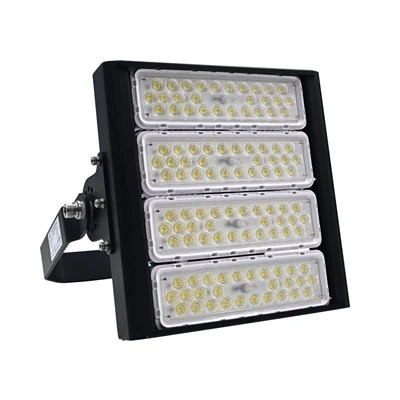
For high-demand environments, the JR309 series offers modular versatility ranging from 50W to 600W. Powered by high-performance 5050 SMD chips, it achieves an industry-leading efficiency of up to 200 Lm/W, effectively eliminating "dark spots" in large-scale venues like stadiums and ports.
Beyond performance, the JR309 features an IK09-rated all-metal structure and a specialized anti-fall buckle design. By interlocking the fixing hook with the lamp body's orbital groove, the unit remains secure even if mounting screws loosen under extreme vibration. Coupled with a 180° adjustable U-bracket, this Outdoor Flood Light Fixtures Waterproof solution provides unmatched safety and precision for the most demanding industrial sites.