
Industrial LED Lighting Intelligent Control System Selection Guide
Jul 17, 2026
Introduction
Traditional industrial lighting faces three main challenges: high energy consumption, complex maintenance, and limited adjustability. Lighting typically accounts for 20% to 40% of a factory's total electricity use. Metal halide and fluorescent lamps have low luminous efficacy and, when operated continuously, result in consistently high electricity costs. In high-bay warehouses with ceilings over 10 meters, replacing a fixture requires a lifting platform, and failures are unpredictable. Lighting is either fully on or off, so areas near windows remain lit during daylight, and lights stay on during breaks or at night when spaces are unoccupied.

LEDs address efficiency concerns, using over 60% less energy than metal-halide lamps at equivalent brightness. However, intelligent control is what shifts lighting from a cost center to a strategic tool. The global LED industrial lighting market is expected to reach $7.798 billion by 2025, with more than 60% of new projects incorporating intelligent control systems. In February 2026, the Zhejiang Lighting Appliance Association released the "Technical Specification for Intelligent Lighting in Industrial Plants" (T/ZALI 0017-2025), establishing industry standards for intelligent lighting.
Core Technology Architecture
The system consists of three layers: sensor data acquisition (illuminance, movement of people/vehicles) → controller decision-making (calculating dimming values according to preset strategies) → luminaire execution (adjusting output of drive power supply).
Wired Control
DALI/DALI-2 (IEC 62386 standard): DALI-2 introduces bidirectional communication, enabling monitoring of luminaire status, energy consumption, and faults. It allows direct bus access for sensors and switches and requires strict interoperability certification. Each fixture has a unique address for precise control.
Infineon Technologies implemented a full DALI-2 project at a large aluminum group's production base, deploying nearly 1,000 driver power supplies and winning the Silver Award for "Industrial Space" at the 2025 DALI China Awards. Another company deployed a DALI-2 system for over 6000 lighting fixtures at its new factory in Shenyang, supporting individual lamp addressing, zone management, and constant illuminance control.
- 0-10V/1-10V: A classic, highly compatible, and cost-effective solution. It offers unidirectional communication without feedback and does not support individual fixture control. This approach is suitable for projects with limited budgets and low precision requirements.
- KNX: A building automation standard that manages system integration, including lighting, air conditioning, curtains, and security. DALI handles dimming execution, and the two systems are complementary.
- PLC Power Line Carrier: Uses existing power lines for signal transmission, eliminating the need for additional cabling. Jiangxi Copper's Detong Dashan plant employs this solution. It is suitable for large-scale projects where new cabling is impractical.
Wired Advantages: Unaffected by electromagnetic interference (critical in workshops with large motors and frequency converters), stable signal. Disadvantages: High initial cabling costs, large amount of retrofitting work.
Wireless Control
- Zigbee/Thread: These self-organizing networks support multi-hop relays and are suitable for high-density lighting environments. The DALI Alliance has released a standard for integrating Zigbee with DALI.
- Bluetooth Mesh: Offers high bandwidth and low latency, with direct connectivity to mobile devices. Each fixture is independently addressable, making it suitable for frequent adjustments and flexible grouping.
- LoRa/NB-IoT: These technologies offer transmission distances of several kilometers and strong signal penetration. Zhejiang China Tobacco Ningbo Cigarette Factory uses LoRa to establish a "smart lighting network." They are suitable for outdoor storage areas, logistics parks, and factory roads.
Wireless Advantages: Reduces installation labor costs by 70%, enables rapid deployment, and allows flexible expansion. Disadvantages include potential susceptibility to electromagnetic interference and signal attenuation through walls.
Practical Implementation: Wired and wireless hybrid systems. The bus layer (DALI/KNX) manages the core lighting circuit to ensure reliability with latency under 10 milliseconds. The wireless layer (Zigbee, Bluetooth, or LoRa) connects sensors and mobile devices. Protocol conversion gateways ensure interoperability.
Practical approach : Wired + wireless hybrid. The bus layer (DALI/KNX) controls the core lighting circuit, ensuring reliability (latency <10ms); the wireless layer (Zigbee/Bluetooth/LoRa) connects sensors and mobile terminals. Protocol conversion gateways facilitate interoperability.
Main Control Strategies
Inductive control turns lights on when people or vehicles approach and off when they leave. This is the fastest-return strategy in the industry.
PIR Passive Infrared: Triggered by changes in infrared radiation from people/equipment. High-bay PIR coverage is 10-15 meters. Extremely low power consumption (<0.5W), but sensitivity decreases in summer when workshop temperatures approach body temperature; requires unobstructed line of sight.
Microwave Radar Sensing (5.8GHz Doppler Effect): Determines movement based on changes in reflected wave frequency. Sensing range 10-20 meters, penetrates non-metallic partitions, insensitive to temperature. Power consumption 1-2W; may falsely trigger near vibrating machinery.
Selection: High-bay warehouses, partitioned workshops → Microwave radar; Narrow passageways, ultra-high spaces (>13 meters) → High-bay PIR.
Energy Saving: Sensor-based control can reduce lighting electricity consumption by 30% to 60%. At Zhangjiakou Cigarette Factory, intelligent control links lighting with production cycles, reducing average daily lamp operating time by 30% and extending lamp lifespan by two to three years.
Constant Illuminance Control (Daylight Compensation): Illuminance sensors in window areas maintain a target illuminance (e.g., 300 Lux). Lights automatically dim in bright sunlight and brighten on cloudy days, maximizing natural light use. A Delta building project combined constant light control and sunshades, saving 826,000 kWh of electricity annually, a 40% energy saving rate.
Scheduled Control: Automatically switches between work, rest, and night modes according to shifts, preventing lights from being left on after shifts end.
One-Click Scene Switching: Preset different illuminance and color temperatures for precision machining, welding, and inspection areas. ZF's flexible production line in Shenyang supports adjustments from 3000K to 6000K.
Application Solutions for Typical Scenarios
|
Scene |
Pain Points |
Plan |
|
Elevated warehouse/logistics center |
High ceilings, long periods of vacancy, and numerous lighting fixtures |
Microwave sensing + zoned group control. The lights normally operate at 20%-30% low power consumption; when movement is detected, the light gradually brightens to 100% along the path in front. |
|
Production and manufacturing workshop |
Operating 24/7, requiring a high degree of concentration |
Constant illuminance control + constant power dimming ensures consistent illuminance at each workstation (300 Lux), Ra≥85, UGR<19. |
|
Flammable and explosive areas |
High security level, difficult wiring |
Explosion-proof wireless intelligent control, 4G/5G IoT cloud management, reducing the risk of electrical sparks. |
|
Cold chain/outdoor storage yard |
Extreme temperature environment, high maintenance costs |
DALI two-way feedback + lifespan warning, remote fault viewing, no need to climb high for troubleshooting. |
Factory renovation data: In an electrolytic aluminum plant, DALI smart lighting achieved over 30% energy savings and extended lamp lifespan by 35%. In an ASP logistics park, energy savings reached 72%, resulting in over 3 million kWh of annual electricity savings and 1.64 million yuan in annual cost savings. In a petrochemical plant, renovating 6,600 lighting fixtures achieved an 87% energy saving rate, with over 3 million kWh of annual electricity savings and nearly 2 million yuan in annual cost savings.
Triple Real Benefits
Energy Saving: Intelligent control saves 75% to 85% of electricity compared to traditional lighting, based on actual power plant measurements. In industrial and warehousing settings, electricity savings exceed 60%, with a payback period of less than one year. Sensors eliminate idle operation, constant illuminance prevents excessive daytime brightness, and timed illumination ensures lights are not left on after work-a triple benefit.
Smart Maintenance: Real-time monitoring of each light's status, temperature, and faults enables automatic reporting, location updates, and lifespan warnings. This shifts maintenance from reactive repair reports to proactive system warnings, reducing manual inspection costs and minimizing risks associated with working at heights.
ESG Support: Visualized energy consumption data helps companies achieve LEED certification and green factory assessments. The Harbin Petrochemical project reduces CO₂ emissions by over 2,000 tons annually, while the Prologis project reduces carbon emissions by an average of 1,750 tons annually.
Key Selection Steps
1. Project Nature: For new plant construction, use wired DALI-2 with infrastructure designed from the ground up for a one-time solution. ZF and large aluminum production bases have adopted this approach. For existing plant renovations, use wireless (Bluetooth Mesh/Zigbee) or a hybrid wired-wireless approach to reduce installation labor costs by 70% with minimal impact on production. Zhejiang Tobacco used LoRa for renovation.
2. Environment: Strong electromagnetic interference (large motors, frequency converters, welding machines) → Wired DALI or proper shielding is required. Dust/High temperature/Humidity → IP65+ protection, microwave radar sensors (not sensitive to temperature). Flammable and explosive environments → Explosion-proof wireless, reducing electrical sparks.
3. Scalability: Ensure the system supports BMS or EMS integration. DALI-2 supports IoT integration by default. Robust systems include Modbus and BACnet interfaces. ZF's project reserved IoT interfaces to support future integration with AGV navigation and digital twins. The lighting system should serve as an entry point to the industrial internet, not as an isolated system.

Product Recommendations
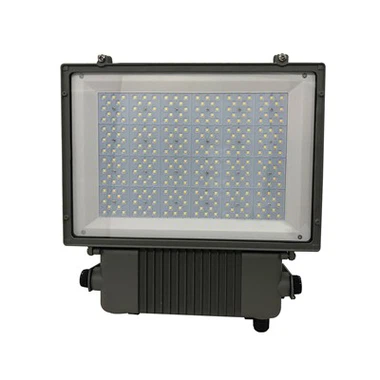
For facility teams seeking maximum energy efficiency, the HL06 series UFO LED high-mounted lights deliver exceptional field performance. Developed by a globally trusted LED lighting manufacturer, this series features a high-pressure die-cast aluminum body with electrostatic spraying for superior corrosion resistance in harsh industrial environments. Its advanced ventilation and heat-dissipation structure optimizes convective thermal management, ensuring the light source operates at lower temperatures.
The HL06 platform offers a luminous efficacy of 150 lm/W and multiple power options: 100W, 150W, 200W, and 240W. It supports a wide voltage input of AC100-277V, with a power factor above 0.95 and a color rendering index (CRI) above 70. Professional beam angles of 90° or 120° are available. The series includes a stable 0-10V dimming function as standard, enabling seamless integration with intelligent control systems to help businesses quickly reduce energy costs.
Frequently Asked Questions (FAQ)
Q1: What are the most mainstream communication protocols for industrial smart lighting? How should I choose between wired and wireless?
A: The mainstream wired protocols are DALI-2 and 0-10V, while wireless protocols include Bluetooth Mesh and Zigbee. For new factories or heavy industries with extremely high stability requirements, DALI-2 wired control is recommended. For older factories undergoing energy-saving renovations or areas where wiring is difficult, Bluetooth Mesh wireless control, which eliminates the need for wiring, is recommended.
Q2: How much electricity can a factory actually save after introducing an intelligent control system (such as sensing and daylight algorithms)?
A: Based on LED upgrades, combined with radar sensing and daylight collection (automatically sensing outdoor light to adjust brightness), the intelligent control system can help factories save an additional 50% to 80% on lighting electricity costs, typically recovering the investment cost within 1.5 to 3 years.
Q3: How can intelligent control systems prevent malfunctions in harsh factory environments with high temperatures, high dust levels, or strong electromagnetic interference?
A: The system needs to use controllers with a high protection rating of IP65 or higher, and employ a split design to isolate heat-sensitive drives from light sources. Simultaneously, wireless control should utilize a self-healing mesh topology to ensure uninterrupted signal transmission even when obstructed by metal equipment or subjected to strong electromagnetic interference.
Q4: What is Networked Lighting Control (NLC), and how does it connect to a factory's IoT or BMS system?
A: NLC refers to a system that connects and manages all lighting fixtures and sensors throughout the factory. It uses open APIs based on industry-standard protocols such as BACnet or Modbus to integrate with the factory's BMS (Building Management System), enabling coordinated energy savings across the entire factory by automatically shutting down air conditioning and exhaust systems in areas where lights are not in use.
Conclusion
Smart lighting forms a closed loop of sensor networks, control decisions, and efficient execution. It is not only about energy savings but also about transforming operations and maintenance-from reactive repairs to proactive early warnings, from unnecessary lighting to on-demand use, and from isolated systems to integrated industrial IoT nodes. With the implementation of the "Technical Specification for Smart Lighting in Industrial Plants" in 2026, the industry has shifted from considering adoption to focusing on effective implementation. Early planning will deliver long-term benefits.