
LED Lighting Selection Scheme for Indoor Sports Venues
Jul 20, 2026
Introduction
Missing a catch due to glare from direct overhead lighting, or capturing video footage marred by rolling horizontal bands-these are 2 common issues in many indoor sports arenas. Lighting for indoor sports facilities is not merely about providing illumination; it directly impacts athletes' reaction times, safety, and the spectator experience, as well as the venue's long-term electricity and maintenance costs. Based on the standards JGJ 153-2016 "Standard for Lighting Design and Testing of Sports Venues" and GB/T 38539-2020 "Technical Requirements for LED Sports Lighting Applications", we present actionable guidelines for selecting LED lighting for sports venues.

Six Golden Standards for Choosing LED Lighting for Venues
Illuminance (Lux) – Classified by Venue Use
Illuminance is measured separately for horizontal illuminance (ground) and vertical illuminance (air). Requirements for different usage scenarios are as follows:
- Amateur Recreation/Fitness Training: 150~300 Lux (horizontal illuminance), basic lighting only required.
- Amateur Competition/Professional Training: 300~500 Lux, uniformity not less than 0.6.
- Professional Competition/HD Television Broadcasting: Horizontal illuminance ≥1000 Lux, vertical illuminance ≥750 Lux, uniformity ≥0.7.
For sports like badminton and volleyball, where the ball often travels overhead, vertical illuminance should be calculated separately.
Anti-glare (UGR) – Control value below 19
UGR (Uniform Glare Ratio) measures the glare level of lighting fixtures. Standards require UGR ≤ 22 for training venues, UGR ≤ 19 for competition venues, and UGR ≤ 16 for badminton halls due to frequent head tilting. To reduce glare, use deep-beam fixtures (beam angle ≤ 60°), install anti-glare grilles or frosted lenses, and position fixtures outside athletes' normal line of sight (elevation angle above 45°).
Color Rendering Index (Ra) and Color Temperature (CCT)
Color Rendering Index: For general training venues, Ra ≥ 80; for television broadcasting or high-definition recording requirements, Ra ≥ 90 and TLCI (Television Light Source Consistency Index) ≥ 90.
Color Temperature: Recommend 4000K to 5000K (neutral to true white), with a maximum of 5700K. Maintain color temperature deviation within ±100K across all fixtures in the same venue to prevent color inconsistency.
Flicker-free – High-frequency constant current drive is a mandatory requirement
Flicker can cause eye fatigue and rolling stripes in high-speed camera images. Select a high-frequency constant current drive with a frequency of at least 2000Hz and fluctuation depth no greater than 3%, in line with IEEE 1789. Require manufacturers to provide a flicker-free test report; do not rely solely on verbal assurances.
Heat Dissipation and Lifespan – Directly Affecting Replacement Costs
Sports stadium lighting fixtures are typically installed at heights of 6-12 meters. The labor and equipment costs to replace a single lamp are approximately 2-5 times the fixture's price. Key performance indicator: L70 lifespan ≥ 50,000 hours (i.e., the time it takes for brightness to decay to 70% of its initial value). The heat dissipation structure must be an integrated aluminum profile with a heat dissipation area-to-power ratio of at least 40 cm²/W. Inferior die-cast aluminum or plastic housing products are strictly prohibited.
Protection Rating (IP / IK)
- IP Dust and Water Resistance: IP54 is sufficient for standard indoor venues; if the venue includes a swimming pool or is in a high-humidity environment, IP65 or higher is required, along with an anti-corrosion coating.
- IK Impact Resistance: High-speed impacts from balls such as badminton, basketball, and tennis balls pose a high risk to lighting fixtures, requiring at least IK08 (able to withstand 5 joules of impact), or the addition of a metal protective mesh.
Refined Lighting Configuration for Different Sports Venues
Badminton/Tennis Court
- Characteristics: Frequent head-tilting movements; avoid direct overhead lighting.
- Lighting Arrangement: Use symmetrical lighting on both sides of the court, with fixtures installed along the sidelines and beams angled outward. Install fixtures at least 6 meters high with an elevation angle below 30°. Do not place fixtures directly above the court.
Basketball/Volleyball Court
- Features: High ceilings, intense competition, and the ball's trajectory must be clearly visible.
- Lighting Arrangement: Uniform matrix lighting from the ceiling (illuminance uniformity ≥ 0.7), supplemented by side lighting at the four corners to enhance vertical illuminance. Light fixtures should be installed at a height ≥ 8 meters, with a beam angle of 30 °- 45 °.
Table Tennis/Billiards Hall
- Characteristics: Small, fast-moving balls require strict tabletop illumination and high contrast.
- Lighting Arrangement: Use concentrated overhead lighting with spacing no greater than 2.5 meters to ensure tabletop illumination uniformity of at least 0.85. Set CRI to at least Ra 90 and color temperature to 5000K to improve contrast between the ball and background.
Smart Bonus Feature: DALI / 1-10V Dimming System
Configured with a DALI or 1-10V dimming driver, with three or more preset scenes:
- Cleaning Mode: 30% brightness, power reduced to 30% of rated level.
- Entertainment & Fitness Mode: 50% brightness, meeting basic activity needs.
- Formal Competition Mode: 100% brightness, meeting standard illuminance requirements.
The dimming system can reduce annual energy consumption by 40%-60% while also reducing the LED light decay rate. For every 10% reduction in brightness, the junction temperature decreases by approximately 5°C and lifespan increases by approximately 20%.

Product Recommendations
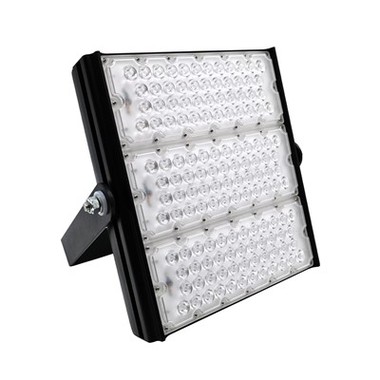
The JR512 linear LED light includes a 304 stainless steel bracket and an AL6063 aluminum alloy heat sink for excellent corrosion resistance. It offers IP66 dust and water resistance, IK10 impact resistance, a lifespan over 100,000 hours, and a 5-year warranty. With luminous efficacy up to 170 Lm/W, it uses high-quality Lumileds chips and Inventronics or MOSO power supplies for high energy efficiency. Its lightweight modular design supports rapid multi-lamp series connection and multiple installation methods. Power output ranges from 50W to 640W, making it suitable for industrial and indoor sports lighting applications.
Frequently Asked Questions (FAQ)
Q1: How to choose the brightness and uniformity of LED lights for indoor stadiums?
A: For general fitness venues, 200 to 300 Lux is sufficient. Professional competitions require 500-750 Lux or higher. Ensure uniform lighting and avoid dark areas or shadows to maintain accurate judgment of ball speed and landing points.
Q2: How to solve the problem of glare from indoor sports lights?
A: Prioritize LED lights with anti-glare lenses or grilles, and avoid hanging lights directly above the court. It is recommended to use side or indirect lighting that utilizes ceiling-diffused light.
Q3: What are the appropriate color temperature and color rendering index (CRI) for indoor LED lights?
A: A neutral or pure white light with a color temperature between 4000K and 5500K is recommended. This helps maintain focus and reduces fatigue. The CRI should be at least 80 to ensure that colors for the playing lines, balls, and floor are clear and easily distinguishable.
Q4: What direct benefits will the stadium receive from switching to LED lights?
A: LED lights are more than 50% more energy-efficient than traditional metal halide lamps and have a lifespan of over 50,000 hours, significantly reducing the hassle of high-altitude maintenance. Furthermore, they are instant-on and flicker-free, making them ideal for high-definition photography and protecting eyesight.
Conclusion
Selecting LEDs for indoor sports venues requires comprehensive consideration of factors such as illuminance levels, glare control, color rendering index, flicker, heat dissipation, impact resistance, and intelligent dimming, all in accordance with national standards. A well-designed system can recover the differences in electricity and maintenance costs within 5 years and enhance the sports experience to a professional standard.
If your venue is facing insufficient lighting, severe glare, or excessively high electricity bills, please contact our professional engineering team. We will provide targeted advice, preliminary design solutions, and DIALux simulations.