
Top 6 Industrial Solar Street Light Applications & Buyer's Guide
Nov 27, 2026
Introduction
When expanding a manufacturing plant, developing a remote mining site, or building a logistics hub, outdoor lighting presents a common operational challenge. Heavy machinery and nighttime freight traffic demand high-illuminance, uninterrupted lighting. Yet traditional grid-tied lighting requires trenching, cabling, transformer upgrades, and utility approvals-driving up upfront civil engineering costs and delaying project timelines.

With advancements in monocrystalline solar panel efficiency and LiFePO4 battery storage, industrial solar street lights have become a practical, cost-saving infrastructure solution. Unlike residential or garden solar lights, industrial-grade models are engineered for harsh conditions, delivering high luminous efficacy (160–200 lm/W), extended battery cycle life, 12+ Beaufort wind resistance, and IP65/IP66 weatherproof protection.
Below are the 6 primary application scenarios where industrial solar street lights deliver the highest operational and financial return.
6 Core Applications for Industrial Solar Street Lights
Large Industrial Parks & Manufacturing Plant Main Roads
The Challenge: Modern industrial parks cover expansive road networks. During Phase II or III plant expansions, trenching existing paved roads damages infrastructure and disrupts daily freight traffic. Additionally, round-the-clock factory operations create high recurring electricity bills.
The Solar Advantage: Industrial solar street lights install without underground cabling. Equipped with smart time-based dimming profiles, fixtures run at 100% brightness during peak evening shift changes and freight hours, then automatically dim to 30%–50% after midnight-ensuring road safety while eliminating ongoing utility costs.
Off-Grid Mining Sites, Oilfields & Remote Energy Bases
The Challenge: Mines, oilfields, and remote extraction facilities typically operate far beyond utility grid coverage. Running high-voltage power lines to these locations is prohibitively expensive or logistically impossible, and fixtures must withstand heavy dust, mechanical vibration, and extreme temperature swings.
The Solar Advantage: Standalone off-grid solar systems turn each pole into an independent power and lighting unit. Die-cast aluminum housings with heavy-duty silicone gaskets prevent dust and corrosive gas ingress, while wide-temperature LiFePO4 battery packs (-20°C to 60°C) ensure reliable nighttime operation in extreme climates.
Logistics Hubs, Seaports & Open-Air Storage Yards
The Challenge: Ports and freight terminals operate 24/7. Container crane operations and semi-truck maneuvering require uniform, glare-free illumination without dark blind spots. Coastal ports also expose lighting infrastructure to severe salt-spray corrosion and typhoon-force winds.
The Solar Advantage: Open yards typically deploy 8m to 12m high-mast solar street lights paired with asymmetric Batwing optical lenses to maximize lateral light spread between poles. Marine-grade anti-corrosion coatings and hot-dip galvanized poles with reinforced base flanges protect against coastal salt mist and high wind loads.
Municipal & Infrastructure Construction Sites
The Challenge: Highway construction, bridge projects, and water infrastructure developments typically last from six months to three years. Installing temporary grid wiring results in sunk costs, as cables and distribution boxes must be abandoned or scrapped once the project concludes.
The Solar Advantage: Modular industrial solar street lights require zero trenching. Upon project completion, contractors simply unbolt the poles from their foundations and relocate the entire lighting system to the next job site-maximizing asset reuse across multiple projects.
Remote Highways, Tunnel Approaches & Border Patrol Roads
The Challenge: Suburban connector roads, dedicated mining haul roads, and border patrol routes often span dozens of kilometers with scarce substation access. Long-distance cabling suffers from voltage drop, high installation costs, and the risk of copper cable theft or single-point grid outages.
The Solar Advantage: Because every light operates independently, damage to one pole never blacks out the entire stretch of road. High-capacity battery configurations engineered for 5 to 7 consecutive rainy days minimize maintenance trips across remote, unmanned corridors.
Large Open-Air Industrial & Commercial Parking Lots
The Challenge: Perimeter parking lots at industrial zones, logistics centers, and commercial complexes require reliable lighting for CCTV security and driver safety, yet running full brightness all night wastes stored energy.
The Solar Advantage: Industrial solar lights with integrated microwave motion sensors maintain a 20% energy-saving standby level when the lot is empty, then trigger to 100% brightness within 0.5 seconds upon detecting vehicles or pedestrians-extending battery lifespan while strengthening site security.
Quick-Reference Specification Guide by Application
Environmental conditions and duty cycles vary widely across industrial sites. Use the reference table below when scoping project specifications:
| Application Scenario | Recommended Pole Height | Suggested LED Wattage | Key Configuration & Protection Priorities |
| Industrial Park Main Roads | 6 – 8 m | 60W – 100W | High-efficacy LEDs, time-based smart dimming |
| Mining & Remote Sites | 8 – 10 m | 80W – 150W | IP66 dust/waterproof rating, wide-temp battery protection |
| Seaports & Storage Yards | 10 – 12 m | 120W – 200W | Anti-salt-spray coating, 12+ wind rating, wide Batwing optics |
| Temporary Construction Sites | 6 – 8 m | 50W – 80W | Modular quick-install design for easy relocation |
| Remote Highways & Patrol Roads | 7 – 9 m | 60W – 100W | Oversized battery bank (5–7 rainy-day autonomy) |
| Large Open-Air Parking Lots | 6 – 8 m | 40W – 80W | Microwave motion sensor, anti-glare optical lens |
Buyer's Checklist: 4 Critical Specs for Industrial Procurement
1,Autonomy Days (Verify Battery Capacity, Not Just LED Wattage):
Low-cost fixtures often advertise high LED wattage paired with undersized batteries that fail after two cloudy days. Size your battery bank based on local meteorological data to guarantee 5 to 7 consecutive rainy days of uninterrupted autonomy.
2,Battery Cell Grade & Cycle Life:
Insist on brand-new Grade-A LiFePO4 (Lithium Iron Phosphate) cells rated for 2,000–3,000+ charge cycles (5–8 years of service life). Avoid recycled or "second-life" EV cells, which degrade rapidly under high ambient temperatures and deep discharge cycles.
3,Smart MPPT Controllers & IoT Monitoring:
For large-scale factory or roadway deployments, specify MPPT (Maximum Power Point Tracking) charge controllers, which deliver 15%–20% higher charging efficiency than older PWM controllers. Adding LoRa or 4G remote monitoring allows facility managers to track battery health and fault alerts from a central dashboard.
4,Structural Integrity & Corrosion Resistance:
Heavy industrial traffic and open terrain create significant wind loads. Poles should be fabricated from Q235 structural steel with a minimum wall thickness of 3.0 mm (3.5–4.0 mm for high masts), finished with hot-dip galvanization and UV-resistant powder coating for 10+ years of rust-free service.
Recommended Products
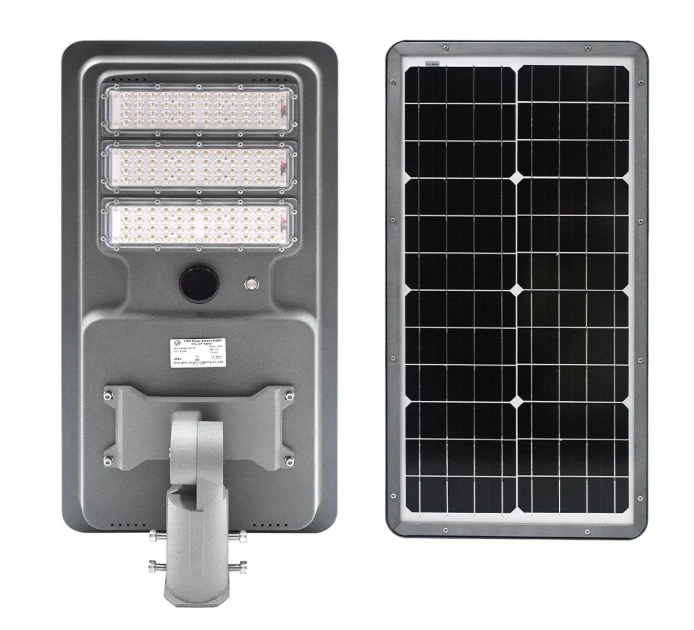
The SSL34 Inbuilt Battery Solar Street Light (20W/25W/30W, ≥3,000–4,500 lm, 150 lm/W) combines a high-efficiency monocrystalline panel, bright LEDs, radar motion sensing, and smart dimming in one sleek unit. Built with a 2,000+ cycle LiFePO4 battery and die-cast aluminum IP65/IK08 housing for -20°C to 60°C operation, it suits 5–8m roadways with reliable, low-maintenance performance.
Frequently Asked Questions (FAQ)
Q1: Which industrial and commercial sites are best suited for solar street lights?
A: Industrial solar street lights are best suited for locations with limited grid access, high trenching and cabling costs, or temporary relocation needs-including manufacturing plant main roads, off-grid mines and oilfields, seaports and open storage yards, temporary construction sites, remote highways, and large open-air parking lots.
Q2: Can industrial solar street lights operate reliably during consecutive rainy days or freezing winters?
A: Yes. Configured with high-capacity battery banks and smart time-based dimming profiles, industrial solar street lights typically sustain 5 to 7 consecutive rainy days of operation, while models equipped with low-temperature LiFePO4 battery protection (-20°C to 60°C) and angled solar panels perform reliably in freezing northern or high-altitude mining regions.
Q3: How do solar street lights maintain durability in dusty mines or high-salinity coastal ports?
A: Industrial-grade fixtures feature IP65/IP66 dust- and waterproof enclosures, marine-grade anti-salt-spray coatings for coastal or chemical zones, and heavy-gauge hot-dip galvanized poles rated for 12+ Beaufort winds-delivering a 20+ year solar panel lifespan and 5 to 8 years of battery service life.
Q4: What is the typical ROI payback period compared to traditional grid-powered street lights?
A: Although the per-unit hardware cost is higher, eliminating trenching, cabling, and transformer expenses often makes the total upfront installed cost equal to or lower than grid lighting, allowing large industrial parks and roadway projects to achieve full ROI payback within 1.5 to 3 years through zero electricity and cable maintenance costs.
Conclusion
Whether you are outfitting a new manufacturing campus, a remote mining haul road, or a coastal logistics yard, proper photometric layout is essential. Contact our engineering team today with your road width, pole spacing, and project location to receive a complimentary DIALux lighting simulation and tailored bill of materials (BOM).