
How LED Stadium Lights Transform Indoor Badminton Arenas
May 20, 2026
Introduction
When managing an indoor badminton facility, court operators frequently focus on flooring quality, net setups, and climate control, while often overlooking the quality of the overhead lighting system. However, premium illumination is an absolute game-changer that directly impacts player performance, visual comfort, and overall venue profitability.
Badminton is a sport defined by lightning-fast rallies, razor-sharp reflexes, and absolute precision. If players cannot track the shuttlecock against a high-ceiling backdrop, the quality of play plummets. Upgrading outdated, inefficient fixtures to modern stadium led flood lights is no longer just an aesthetic choice-it is a critical operational strategy that cuts massive energy costs, eliminates player frustration, and maximizes court utilization rates.
The Hidden Costs of Poor Stadium Lighting in Badminton Arenas
A staggering 60% of indoor badminton halls suffer from substandard lighting layouts. Operators face severe structural and financial pain points due to legacy illumination systems:
- Substandard Lux Levels: Many traditional indoor sports facilities operate at lux levels of only 200-300. This falls drastically short of the 500-750 lux benchmark mandated by the Badminton World Federation (BWF) for professional play. Low light levels cause players to misjudge the shuttlecock's speed and trajectory, leading to unforced errors and a poor sporting experience.
- Blinding Glare and Eye Strain: Legacy systems often present a Unified Glare Rating (GR) well above 30. Sometimes peaking between 31 and 35. When a player looks up to smash or clear a high-flying shuttlecock, excessive glare causes temporary visual blinding, acute eye fatigue, and an increased risk of on-court injuries.
- Frequent Burnouts and Prohibitive Maintenance Costs: Conventional metal halide or high-pressure sodium bulbs have a short lifespan of only 10,000 to 20,000 hours. For a commercial venue running multiple courts, replacing dead bulbs requires hiring specialized lift equipment. In a typical 12-court arena, the cumulative cost of replacing traditional lamps can skyrocket to $1,000 per fixture when factoring in labor, bulb costs, and court downtime.
- Astronomical Energy Bills: A standard 1,000-square-meter badminton hall using legacy lighting draws roughly 50-60 kWh per hour. This massive energy consumption eats directly into a facility's monthly profit margins.
Core Advantages: Why Sports Operators Are Upgrading to Modern Lighting Systems
| Performance Matrix: LED Stadium Lighting vs. Traditional Systems (HID/MH) | ||
| Feature | LED Stadium Lighting | Traditional Lighting (HID/MH) |
| Energy Efficiency | High efficiency (saves 60-70%) | Low efficiency, high electric bills |
| Lifespan | 50,000 to 100,000 hours | 5,000 to 15,000 hours |
| Light Quality | Uniform brightness, high CRI, better shuttlecock tracking | Uneven illumination, low CRI, prone to shadows |
| Warm-Up Time | Instantaneous On/Off | Requires prolonged warm-up & restrike delay |
| Maintenance Costs | Minimal overhead, long replacement cycles | Frequent bulb blowouts, high maintenance downtime |
| Glare Control | Advanced anti-glare optics (Glare Rating < 30) | Uncontrolled glare (Glare Rating > 31-35) causes eye strain |
1. Exceptional Brightness & Uniformity: Tracking the Shuttlecock Seamlessly
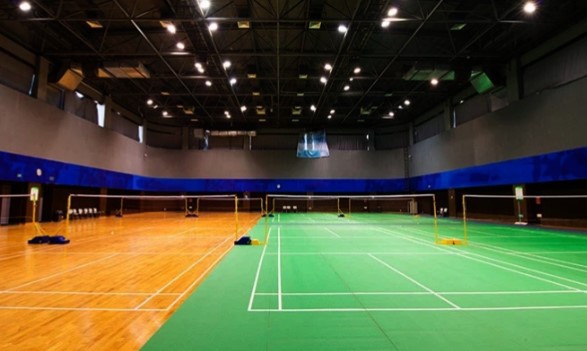
Standard double courts measure 44 feet (13.4 meters) long by 20 feet (6.1 meters) wide, requiring a vertical clearance of at least 20 feet (6.1 meters) to accommodate high clears. Upgrading to a premium LED stadium light setup guarantees an average illumination level of 800 to 1.000 lux across this entire envelope. With an exceptional uniformity ratio exceeding 0.7. Shadows are entirely eliminated. Players can track the fast-moving shuttlecock effortlessly from the baseline to the net without experiencing sudden drops in visibility.
2. Advanced Glare Control: Protecting Players' Vision
By using precision-engineered optical lenses, professional-grade LED sports floodlights actively direct light downward onto the playing surface rather than scattering it into players' eyes. This advanced optical design keeps the glare rating well below 30. Players maintain perfect focus on high overhead shots, enabling longer, more competitive rallies without the burden of visual fatigue.
3. Extended Lifespan & Near-Zero Maintenance: Slashing Operational Costs
The LED stadium lights factory ensures that industrial LED sports fixtures deliver a reliable operating lifespan of 50.000 to 100.000 hours-up to ten times longer than legacy alternatives. For a commercial sports hub, this longevity translates to years of continuous, uninterrupted operation. Venue managers can eliminate the recurring logistical headaches, labor overhead, and lost revenue associated with fixing burnt-out bulbs on high ceilings.
4. Extreme Energy Efficiency: Cutting Overhead by 60%
Replacing high-wattage traditional lamps with high-efficiency stadium LED flood lights allows clubs to trim their lighting power consumption by 60% or more.
Real-world deployments show the staggering financial impact of this conversion. For instance, an indoor badminton venue in the United States had dim 350 lux courts, a harsh glare rating of 35, and frequent bulb failures while drawing 55 kWh per hour. After deploying high-performance sports LEDs, the venue boosted court brightness to a crisp 850 lux and enhanced uniformity to 0.75, while dropping the glare rating to 30. Most notably, hourly power demand plunged to 25 kWh, yielding an incredible $30,000 in annual utility savings alongside significantly lower maintenance costs.
Beyond Illumination: Enhancing the Player and Spectator Experience
Modern sports lighting upgrades provide flexible, smart integration capabilities that traditional systems simply cannot match. Unlike older metal halide bulbs, which require lengthy warm-up and restrike periods, LEDs deliver instant-on performance.
Furthermore, integrating advanced dimming capabilities enables club managers to adjust light levels in response to real-time court usage. Illumination can be dialed up to maximum intensity for high-stakes tournament play and dimmed during off-peak practice hours or general training. This smart capability creates a premium, modern atmosphere that attracts elite players, keeps courts booked, and further optimizes energy savings.
Featured Solution: Engineered for Peak Athletic Performance
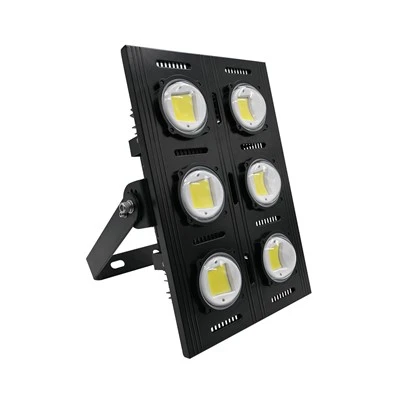
To permanently resolve court lighting inefficiencies, our JR502 Series LED Sports Flood Lights offer the ultimate targeted solution. Featuring power configurations from 100W to 300W and an efficiency of 140 Lm/W, this system features integrated cooling technology for rapid heat conduction and an extended 50,000-hour lifespan. Built with a rugged, automotive-grade three-layer anti-corrosion housing (IP65/IK08), it delivers professional multi-angle light distribution (25°/60°/90°) and supports light-sensor automation for seamless, intelligent court control.
FAQs
Q1: How many lux should a professional indoor badminton court have?
A: For recreational play and general training, an illumination level of 300 to 500 lux is typically acceptable. However, for professional training, official club tournaments, and international matches, the Badminton World Federation (BWF) recommends a strict standard of 500 to 750+ lux across the playing zone to ensure clear visibility for athletes and officials.
Q2: What is the ideal mounting height for indoor badminton court light fixtures?
A: To prevent visual obstruction and accommodate high-flying shuttlecocks, lights should be mounted at a minimum height of 20 feet (6.1 meters). For top-tier professional facilities, fixtures are often mounted between 8 and 12 meters high and positioned along the sides of the court rather than directly overhead to reduce glare.
Q3: How do anti-glare lenses improve player performance in racket sports?
A: Anti-glare technology utilizes precise internal optics to shape the beam angle, cutting off stray light that would otherwise blind a player looking upward. Keeping the Unified Glare Rating (GR) under 30 eliminates sudden blinding flashes during smashes, drastically reduces eye strain, and allows players to react faster.
Q4: Can switching to LED sports lighting really lower my club's operating costs?
A: Yes, significantly. High-efficiency sports LEDs draw up to 60-70% less power than outdated high-intensity discharge (HID) or metal halide lamps while outputting identical or superior brightness. When factoring in lower monthly energy bills and the elimination of frequent bulb changes, most clubs achieve a full return on investment within 12 to 124 months.
Final Thoughts
Upgrading an indoor badminton facility with premium sports lighting is a strategic operational investment that yields immediate dividends. By replacing dim, high-maintenance traditional bulbs with state-of-the-art LED sports flood lights, facility operators can eliminate distracting glare, boost visual clarity, and slash energy costs by more than half. Providing a crisp, professionally lit playing environment enhances player safety, maximizes court bookings, and secures your facility's position as a premier sporting destination.